
Mayong Rice Terraces
Mayong Rice Terraces, Munduk Waterfall, Lake Tamblingan and Lake Buyan, and Pura Ulun Danu Beratan all prove the power of harmony between God, nature, and people
Driving from the western part of Bali, on our way to the northern villages where the island’s famous lakes are, I was intently listening to what our guide Artana has been explaining about a unique Bali irrigation system—so unique that five iterations of it in other parts of the island, though not exactly the parts we were heading to at that point, have been declared by UNESCO as World Heritage Sites for their cultural value. It’s an irrigation system applied all throughout the farmlands of Bali and has been part of Balinese life for over a thousand years now. It’s a system that represents the relationship between God, nature, and the people of Bali, and is thus a cornerstone of the Balinese Hindu faith.
Of course, these were all still in the abstract as I was hearing the facts. But the facts would make sense very soon enough, and acquire more and more meaning, as we come across one manifestation after another of this God-nature-people harmony. Fittingly, Artana first brought us to a sweeping view of a farm, in Mayong village.
Mayong Rice Terraces
Mayong village in northern Bali, under the Buleleng Regency, bears acres upon acres of rice terraces—in rolling flat plains, or in varying heights based on the contours of the land, sometimes in elevated hillslopes, sometimes in deep valleys. Artana said these rice terraces can be explored better through cultural walks, if the traveler can set aside more time to trek and be settled within the village. There are also other picturesque rice terraces in other regencies, such as the more visited ones in Tabanan and Gianyar, “but this one is exceptional,” he said, stressing that these rice terraces of Mayong are so fertile, they produce not only rice but loads of mangoes and grapes as well, earning for Mayong the nickname “fruit basket of Bali.”
As it turns out, he’s right. Indeed, the more discerning travelers of Bali tend to really go up north and seek these terraces, because one, they are not in the usual tourist checklists, and two, the subak system also works through these rice terraces’ entire width and breadth. Artana then continued his explanation of the subak system, but with the rice terraces now before me, this student finally got some visual aids. Subak, he said, is the water-sharing system that distributes the water from huge natural sources to all the rice fields in Bali. From a natural water source, like a lake, the water travels through handmade natural reservoirs and catchments, through rivers, canals, bamboo pipes, ditches, and tunnels. From what I understood, there’s something like a schedule observed, ensuring that every farm receives water. Farmers are assigned certain times when they’ll let the water flow to the next farmer’s paddies, and so on and so forth, until the water reaches the last farmer within that subak. This last farmer, who receives his share as last in the rotation, is the one positioned within the system to then let the water flow back to the main source. But it doesn’t end there.
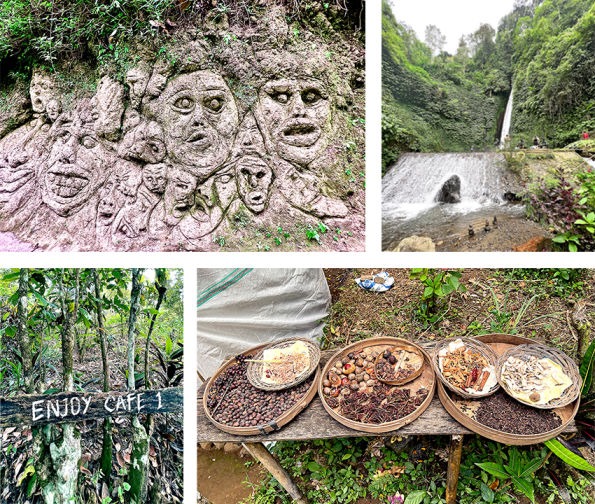
Relief face carvings on stone on the way to Munduk Waterfalls; another view of the waterfalls; locals selling spices on the roadside and a cafe's rustic sign
At certain points within the subak, water temples are strategically erected. Priests are assigned to watch over these temples, Artana explained, just as there are farmers assigned to manage the rotation of the water. But the spiritual responsibilities do not fall solely on the shoulders of the priests. Everyone in the subak system conducts prayers and makes offerings to the gods of the water and many other gods and spirits connected to this environment. And there are many water temples all across each subak of Bali, just as there are various kinds of ceremonies and prayers that the farmers and their families do. This should explain some processions of men and women I chanced upon seeing in our drive, and which Artana explained could be groups coming to or from a water ceremony.
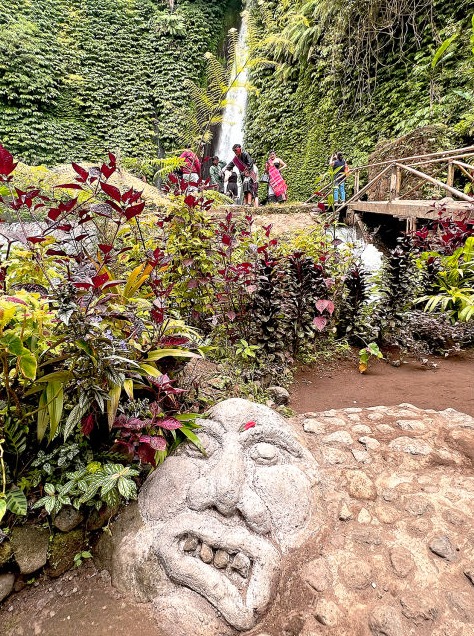
Another face relief
I cannot see how subak, both systematic and spiritual, would not work in Mayong or the rest of Bali. It’s the first time I saw the existence of an ancient irrigation system, one that actually returns the water back to its source, and without any environmental impact or human displacement caused, such as in the case of our modern dams. For us who were raised and live outside of Bali, what we mostly know of irrigation is simply receiving from it, and praying that despite our mindless and endless taking, our sources are never depleted. We only know how to ask for what we want, to ask for miracles and the impossible. But the Balinese Hindu who manage the humble subak, from the priests all the way to the farmers, actually work with the spirits and their gods. How then can these gods withhold or say no?

Munduk Waterfall acts as a picturesque backdrop for wedding and pre-nuptials photos.
I continued to see subak in action on our trek downward to reach Munduk waterfall, still in the highlands of Buleleng Regency. If in Mayong I saw what subak irrigates—the rice paddies—here in our descent to Munduk waterfall, I actually witnessed the tactile workings of the system. I saw an intricate natural engineering wonder of bamboo pipes, ditches, and catch basins, all of which transport the waters of Munduk to its farmland destinations. But aside from the unique waterworks, our trek also showed me a distinct jungle village.
Stone steps and narrow pathways, spacious enough for scooters to even pass alongside trekkers, made up our path. Although it does get steep, it was smooth enough to be walkable. At one point of the trek, a companion even pointed to me carvings of faces on a stone wall. Later on, a couple in traditional Bali wedding attire went past us to have their prenup photo shoot. We also saw occasional stores and stalls on the sides of our path, selling various types of nuts and spices. Much later in our trek, actually when we were already heading back up, Artana pointed to a slope across a valley, also thickly forested, and he said, “It doesn’t look like it, but there are families there.” But that’s getting ahead of the story.
After about 20 minutes into our descent, in my estimation, we finally reached our destination—Munduk Waterfall, rushing like white silk from the top of the mountain and crashing down to the ground. Only a few other travelers were with us when we reached the waterfall, most of them quite busy taking their selfies with the waterfall in the background. Can’t really blame them, because among all the other waterfalls nearby, Munduk waterfall is supposed to be the most picturesque. After they were done, I took my turn at the closest safest point to the cascading water, dipped my fingers into the cool shallow pool below, and scooped up a little of the water to taste—cool and clean.
“Like in all of Bali, there is a temple on top of the water source, to thank god for the energy,” Artana said, pointing up to the top of the waterfall, about 20 meters high. Thus, water really passes through the temples, and I’d like to believe I just licked and sipped some holy water. I wanted to have a bit more to drink but the mist was clouding up my glasses and I had to give room to another traveler. As I and our group started our trek back up, which would take roughly 30 minutes, we again came across the Balinese couple now heading to the foot of the waterfall. I could not resist taking shots of them as they posed, hands reaching out to each other, amid the mist of a waterfall gloriously gushing.
The famous twin lakes of Buleleng Regency, Lake Tamblingan and Lake Buyan, are both rustic destinations from the vantage of the cliff where we viewed them. Lake Tamblingan, known to be a holy lake among the locals, is surrounded by lush forests, and temples which we were not able to see because we opted for the panoramic view from above. Its surface elevation stands at 1,200 meters above sea level, so no wonder it was so chilly around it. It obviously looks smaller than its twin, and is in fact the smallest lake in the ancient caldera where it sits, along with Lake Buyan and the third lake we will see much later, Lake Beratan. As for its depth, it runs at 300 feet or less than 100 meters deep, and covers about 1.6 square kilometers of surface area. Aside from forests, farms for rice, coffee, and vegetables are also said to surround it.
As for Lake Buyan, it takes up a slightly higher elevation at 1,300 meters above sea level and is far bigger with a surface area of about 4.5 square kilometers. It runs slightly less deeper though at something between 60 to 80-plus meters, and is surrounded as well by rice, coffee, and spice farms. In between Lake Buyan and Lake Tamblingan, meanwhile, is another strip of forest that separates them. The atmosphere overall was misty and foggy, amid deep greens and moody grays. But the day was anything but gloomy because I know that this is a place that nourishes its quiet village of farms and people.
For our last stop in our journey of northern Bali, we headed to the last lake in our plan, Lake Beratan (or Bratan). As for specs, it covers 3.8 square kilometers of surface area, stands at an elevation of over 1,200 meters above sea level, and goes about 22 meters deep. That’s quite shallow compared to the twins it shares the same ancient caldera with, but nonetheless, perhaps this lake could be regarded as the third member of a triplet. Or maybe a distant cousin, because technically Lake Beratan is already part of a different locality, being under the Tabanan Regency, and in another highland area, Bedugul highlands.
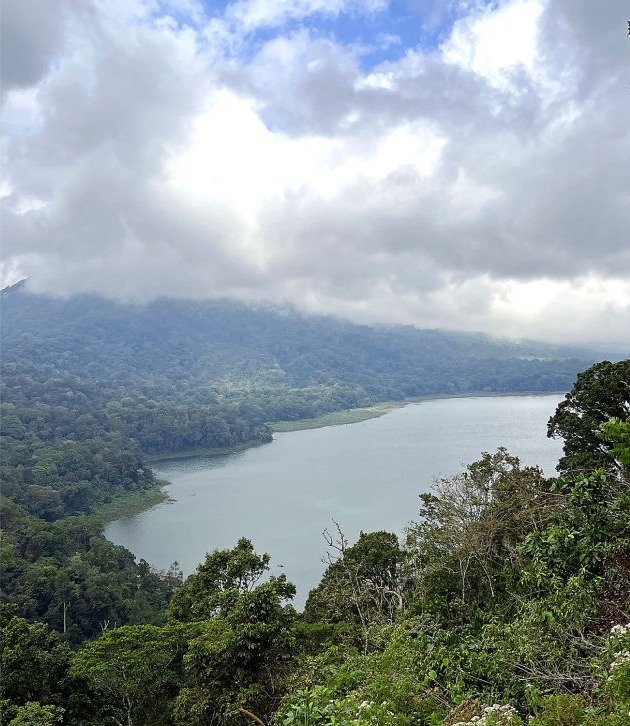
Lake Tamblingan

Lake Buyan

Image Description
The attraction of this destination is not exactly and strictly the lake, though, because what steals the show here is the temple on it, Pura Ulun Danu Beratan. This world-famous temple even had its image figure in the old 50,000 rupiah bill. In contrast with the spots we went to earlier in the day, Lake Beratan and its temple complex is extremely busy with tourists, even busier than the equally famous temples at Tanah Lot which we visited days earlier. But that did not discourage me from being pleased with the garden landscape of this lake’s temple complex. Towering alpine trees, bountiful blooms such as marigolds, bougainvillea, and frangipani, and what looked like red lilies on the lake all delighted me and made me forget about the crowds.
The grounds run expansive and I was easily tempted to break free from our group to venture on my own every once in a while. The existence of a Buddhist stupa within the gardens amazed me, and so did the varying tiers of each shrine I saw—the iconic 11 and three at the lake, and seven in a locked shrine where non-worshippers are prohibited. I even noticed a huge blue-domed mosque at a distance, which turns out to be the Masjid Besar Al-Hidayah, and as I wondered about its exact location in the mainly Hindu island, I suddenly remembered my guide who has the answers, and whom I seemed to have lost.
I first found one of our companions, Sir Gab, standing across the temple at the lake. “Look for him, he’s looking for you!” sir Gab laughingly said, referring to Artana. Sir Gab, as our photographer, by this time has accomplished his goal of shooting Pura Ulun Danu Beratan in all its uncanny allure, and he’s now ready to proceed to the next part of our journey, towards central Bali—so I really need to already find our guide who’s trying to find me. But no problem, because just a few seconds of ambling around and I quickly spotted Artana, in his red shirt and sarong, crowned by his udeng. Of course I could not yell across holy grounds to catch his attention, so I had to march my way through all my fellow restless tourists, to approach him. He did not look relieved at all when he saw me coming, so maybe I and sir Gab were not even lost from his sight the whole time, despite the endless flow of the Lake Beratan crowds, all these people from all over the world constantly moving in a slow mumbling buzz. Perhaps to this Balinese man, we are all simply like ripples on the misty holy lake, with its water that ultimately finds its way to every piece of land it needs to nourish.

Website Software