SURABAYA: WHERE WE LEARN TO BECOME BETTER TRAVELERS
This city in east Java, renowned for being the birthplace of heroes, gears up to secure a leading spot in Indonesian tourism.
This city in east Java, renowned for being the birthplace of heroes, gears up to secure a leading spot in Indonesian tourism.
“Why are we starting this tour in a graveyard?” This was the immediate question that came to my mind as I and my companions entered the grounds of Makam Eropa Peneleh, the old European graveyard in Surabaya. I dared not voice out the question, and as I would later find out, I was right in holding back, otherwise I would have appeared tremendously silly to my excellent and patient guide Sherly, a local Surabaya gal. In the first place, she did not even need to hear the question to answer it.
She simply dutifully pointed out significant details in the place – the solid steel entrance gate with the bullet hole from the Second World War, a plot bearing the name of 48 nuns who died from a virus, a plot of Freemasons, and her own family's ancestral plot bearing the surnames of De Vries, as she apparently has Dutch ancestry – and she instantly led me to answer my own thoughtless, if not insensitive question. Perhaps we were starting in this graveyard because here lies the remains of people who were not Indonesian and yet are recognized and remembered by Indonesians who fought with their very lives for freedom. And as I would later learn more about Indonesian values in Surabaya, they are a people whose revolutionary past burns with passion to this day because they are freedom-lovers.

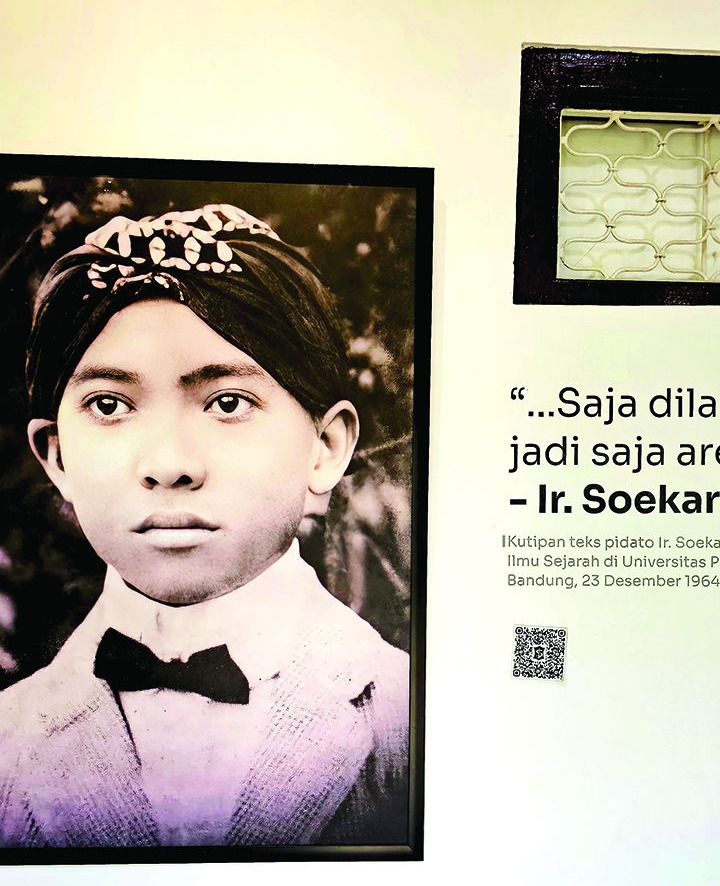
Clockwise, from top: Appreciate Indonesian history with stops at Soekarno's birth house and dormitory, statues of Soekarno and Hatta to commemorate the declaration of independence, the iconic "inverted nail", Museum of November 10th.
One of Surabaya's draws as a destination is its being the birthplace of Indonesia's first-ever president, Soekarno. In Kampung Peneleh, even before we arrived at his birth house, passing by the Jobong well made me see that I was not only walking through streets that would lead me to the home of a revered historical figure – I was also stepping on revered ancient grounds. Jobong well was accidentally discovered during a ditch-digging project in 2018, when workers suddenly hit and found a “two-stacked jobong using terracotta cylinder (made of clay),” dating as far back as from the days of the Majapahit empire.
In just a few more steps, we approached Rumah Kelahiran Bung Karno, Soekarno's birth house, a small white house where the young Soekarno was raised by his Javanese father and Balinese mother. This house was chosen by Soekarno's father for its proximity to school and Balinese neighbors, in consideration of his mother whom his father wished not to be too homesick. While the house looked simple outside, the interiors have been impressively restored, with audio-visual exhibitions that educate visitors about the early life of Soekarno.
Still within the area, we soon reached Soekarno's boarding house, where he stayed when he was 15 years old and even met his first wife, the daughter of his teacher who also owned the boarding house, Tjokroaminoto. As with the birth house, this boarding house retains the structure of the old days, even featuring the same steel ladder used by Soekarno to climb up to the second floor where he roomed.
On another day, Sherly brought me and my companions to the Tugu Pahlawan or Heroes Monument. Several designs were presented to Soekarno prior to its construction, all of which he rejected for being similar with grandiose western designs. He wanted something impactful, saying that the monument should look something like an inverted nail, simple yet can pose danger upon anyone who attempts to step on it. His words were taken to heart by the designers and builders. I saw the monument on a day when the sky was solid blue, and it gleamed immaculately white amid a few patches of clouds. Who needs to see obelisks on the other side of the world when I can behold this ASEAN icon?
Right below the monument, we descended into the Museum Sepuluh Nopember or Museum of November 10th. The date pertains to National Heroes Day, which commemorates the Battle of Surabaya, where Indonesian nationalists fought to resist the re-imposition of Dutch colonial rule. In this museum, I had a crash course on probably the most important milestone in Indonesia's history, the proclamation of independence on August 17, 1945. The museum is another proud bearer of relics of Indonesia's freedom-fighting past – weapons, loot, dioramas, and artifacts from the war in Surabaya. I even got to watch in here a documentary on the war.
At one point I had to ask Sherly whether or not she faces resistance from travelers who might want to skip historical legs of a Surabaya tour. Beaming, she told me that this leg is “always a part” of her tour, and she said this without embarrassing nor scolding me for yet again what could possibly be a silly and insensitive question. …For why would anyone want to skip a leg that is crucial to the identity of the place? I feared she might think I'm just like any other tourist only after food shots and other Instagrammable spots. Instead, she answered with pride and conviction so infectious that yet again it was as if I had been given a full bank of multiple answers. She actually pointed out that a lot of her guests look forward to these stops, especially Asian and domestic travelers of scholarly or intellectual inclinations.

Suroboyo Park
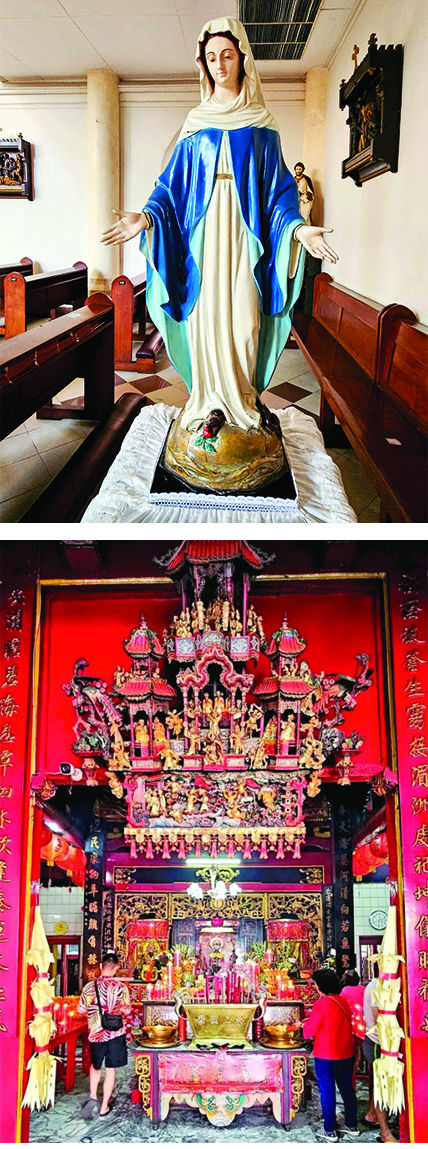
Top: Kepanjen Church, Bottom: Sukhaloka Temple
Surabaya is aware of its somewhat niche characteristic as a travel destination. As Surabaya's head of tourism section Farah Andita Ramdani explained, not everyone will be interested in history which is what Surabaya is strong at. But on the upside, this means Surabaya tends to attract a more intentional kind of traveler, those who are into enriching themselves by becoming knowledgeable travelers while enjoying the perks of leisure. This is where Surabaya's magnet for attracting MICE tourism makes even more sense.
“Even before COVID-19, Surabaya has been famous as a MICE destination for international workshops. So, that's very specific, not really on exhibition or concerts but international workshops. So people know Surabaya, most of them researchers, scholars, public officials,” Ramdani pointed out. “They want to come to Surabaya because they see that there are so many things that they can learn.”
When we say learning, it is also not confined to learning about Surabaya, because people also come here to learn from Surabaya. As an example, Ramdani cited how Surabaya has been a model for MICE travelers wanting to learn about how the city has become “the cleanest and greenest city in Indonesia.” But she is also frank about Surabaya being in that spot where it is still yet to maximize potentials. She said Surabaya may be the place in mind “in terms of business and trade, but tourism is where Surabaya can still grow.” The goal is to strengthen the links between business and leisure, because finance and trade are the main drivers of tourism in Surabaya. Currently, the largest share of travelers that come here are still from the ASEAN, with Malaysia leading the pack, followed closely by travelers from Singapore. From the domestic front, eastern Indonesian travelers dominate, with a lot of them coming to Surabaya to shop. Ramdani said ASEAN is a market they wish to expand more into.
She acknowledged as well how local government units have been working together under the leadership of their mayor Eri Cahyadi, who sees tourism as the frontier Surabaya economy. She shared, “It really brings big impact when everyone comes to us and says, 'What can we do to help you?'” As for community support, she gave due credit to Surabaya citizens, particularly kampung residents, for being the implementors of the successful clean-and-green campaign which is the foundation of the tourism program. When I asked her about how Surabaya encourages locals to not succumb to commercialism by selling out their properties identified as heritage structures, she answered me with the very same endearing conviction I also hear from my guide Sherly: “We do not convince them but we make regulations.” It is something upon which we heartily laughed over, as I answered her back, “That's even better!”
What's good about being sufficiently knowledgeable of such a historical destination as Surabaya? I would like to think of it as doing one's homework first, so I can happily play later. After seeing Surabaya's museums and monuments, all the rest of the attractions appeared to be even more vibrant. And that vibrancy's beating heart is right at Surabaya's Old Quarter.
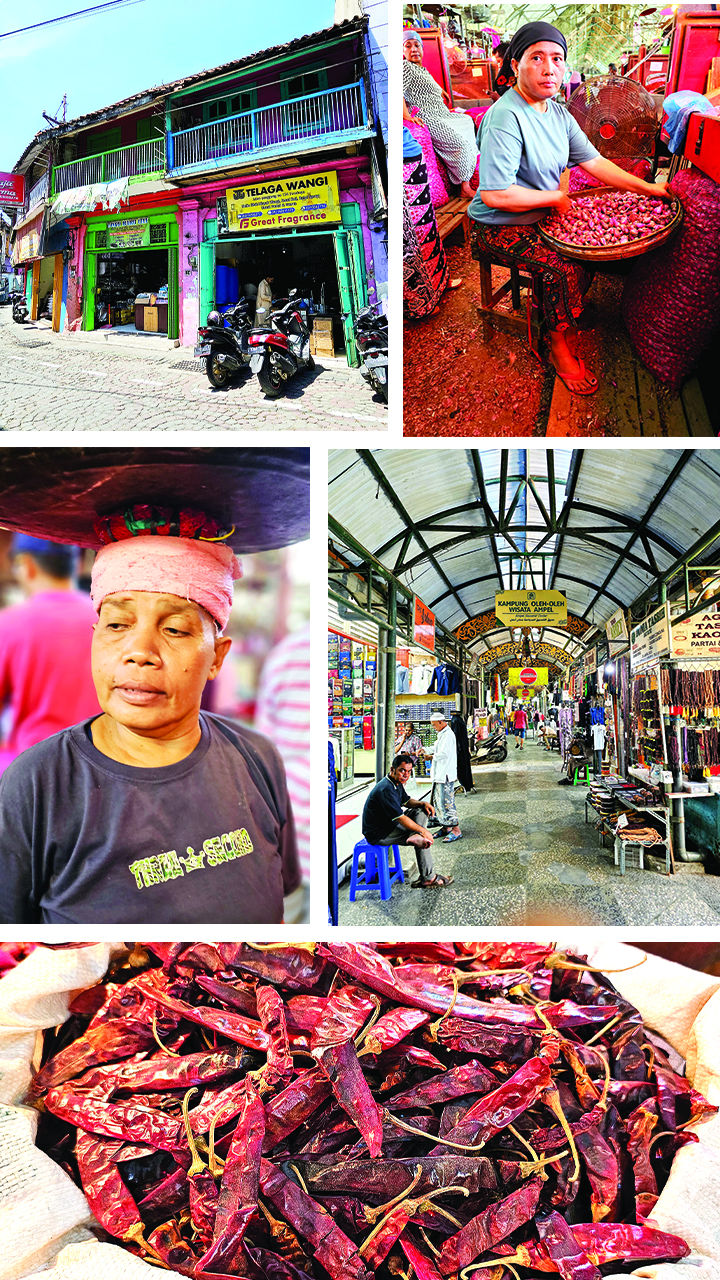
We started off our journey from Jalan Kembang Jepun in the old business center. We then proceeded to Pasar Pabean or the Pabean Market, an old traditional market established in 1849 during the Dutch colonial era, and still bearing its neoclassic style. All my senses were activated as we stepped inside and saw all the spices for sale: ginger and galangal, cinnamon and nuts, tamarind blocks and sauces in packets, and onions and chilies. Next stop was Jalan Panggung lined with colorful old shophouses. We continued walking until we reached the Ampel area.
The Ampel Mosque of the Arab Quarter stands as one of the many proofs of the openness and diversity of Indonesian culture. Why? Because right at the top of the mosque roof is a Hindu crown! This mosque has also never really been renovated, only painted on, thus it still is very much the same ancient structure, the oldest mosque in eastern Java.

Even the place where we had our lunch during our Old Quarter day has a colorful past. The Arch Bistro of Kokoon Hotel is within a 1920 building which was originally a matchmaking factory. And while I equally relished our previous day's lunch at a popular IBC outlet and a later dinner at the posh G-Walk, I must admit that there's a unique high from marveling over Kokoon's collection of antique clocks and Dutch refrigerators as we waited for our food.
The last place of worship we visited was the Tri Dharma Temple, or the Sukhaloka Temple. Just as Ampel Mosque embraces in its symbolic design Java’s and Indonesia's multicultural roots, this particular Chinatown temple is also a home to three kinds of Chinese-Indonesian faith – Confucian, Taoist, and Buddhist. Sherly and I walked from one altar to the next to view locals saying prayers and making offerings.
We ended our Surabaya journey by taking the 2-kilometer Kalimas River cruise, where I saw the old colonial governor's residence, the city's special area for street food sellers, and Surabaya's skyscrapers all lit up for the night. I was hugely impressed by how clean and clear the water is, and by how cool and fresh the air is. We disembarked at the port right next to the Museum Pendidikan Surabaya for a quick overview of the development of education in Indonesia. Then I could not help but ask the museum guide-staff and Sherly another string of my silly questions – “What is Bahasa for stupid? And what is it for smart?” Bodo and pintar, respectively, they said, while all three of us laughed.
Thank you for helping me grow, from being a bodo traveler to hopefully a pintar one, brave and brilliant Surabaya!

HTML Creator