WESTERN BALI: HAPPY TRAILS, HEADY AWAKENING

A very early morning trek inside the West Bali National Park can lead to environmental awareness with a little dash of laughs

“Do not touch anything.” This was the one rule-slash-advice that our guide, Gede, dispensed upon us as soon as we were done with the morning pleasantries and introductions. It was 7 a.m., our entourage was still rather woozy from the 6 a.m.-ish call time, and no one had had breakfast yet. We were given a hint that we’ll have a picnic-style one right in the middle of the jungle—after about a few kilometers of trekking; a few kilometers meaning at least two. I didn’t even have my day’s first dose of coffee yet, a serious mistake, I thought, but the warning from Gede was quite enough to jolt me off my stupor, pumping up the adrenalin’s message to my central nervous system: “He said don’t touch anything, sleepyhead, which means wake up now and don’t be stupid.”

We were about to embark on a 4.2-kilometer trek through the West Bali National Park, one of Indonesia’s fifty-plus national parks, and which comprises about 3% of Bali’s land area, according to Indonesia’s Ministry of Forestry. We were at the westernmost part of the island, with east Java just across the coast, and deep within the national park’s entire 19,000 hectares, out of which 15,000 hectares is land and over 3,400 hectares is water. Massive, right? So, should I doze off at some point, and accidentally touch something as I fall, then get left behind by the pack hustling for the picnic breakfast, does that mean they would have to look for me later within 15,000 hectares of wilderness?

Luckily for me, as per Gede’s handy stats, our particular trek is only within the 382 hectares of the national park which is under the care of Plataran Menjangan Resort & Spa, being located in an integrated Eco-Development Area of the park—only 10% of which comprises the resort proper while the remaining 90% is for pure conservation. That means should I indeed get knocked down by anything lethal that I touch, my companions would only need to look for me through the 90% of the Plataran-supervised 382 hectares, right? Or maybe just within the path of our Trails of Life park activity, the easy 4.2 kilometers before the breakfast picnic.

At any rate, in between Gede’s kindly Balinese prayer that sent us all off, all the way to our highly-anticipated jungle meal, this was how I pretty much appreciated most of the numbers I was hearing. Until of course we got deeper into the trek, when my adrenalin started behaving, and the numbers ceased from being just numbers – instead manifesting as lively wild creatures, and dazzling plants and trees. 

Mobirise Website Builder

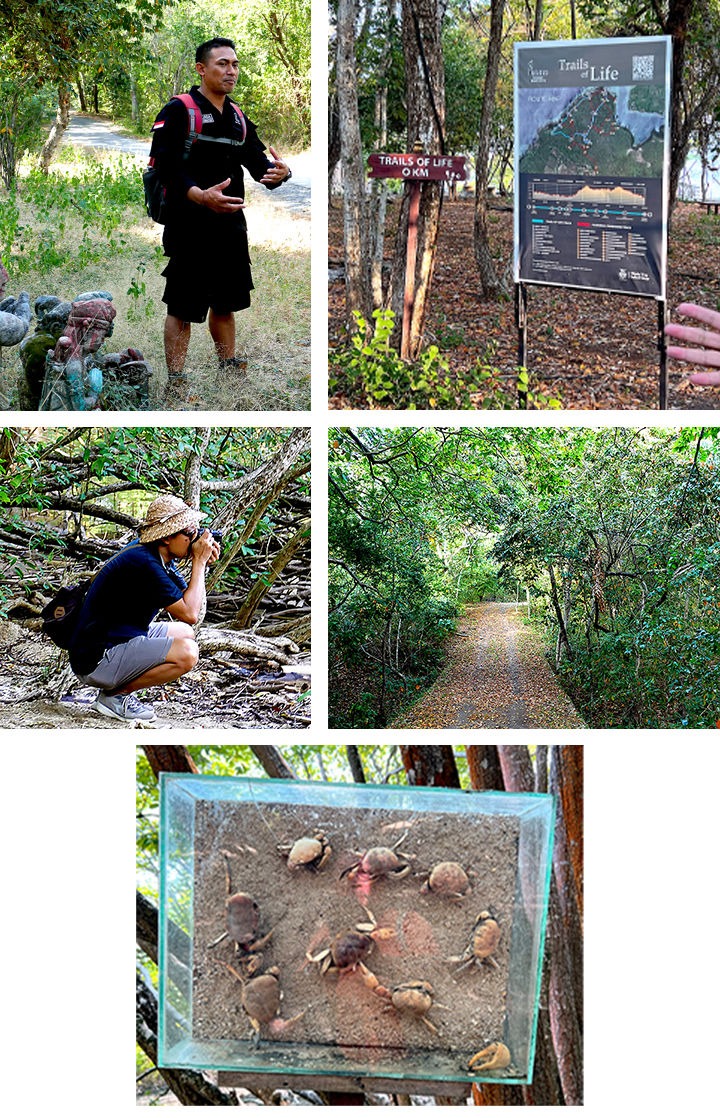
Clockwise from top left: our guide Gede, the starting point of our trek, a rare smooth part of the trek, the remains of ghost crabs, our handler Adjie taking naps of the viree  

Traipsing among the flora

I really gotta give it to Gede, he’s no natural scientist nor a wildlife show host, but his practical knowledge served us well as he guided us through the wilderness of the West Bali National Park. He started out as a worker-builder in the resort, until he was designated as a ranger, and later on, as a guide. While cutting or clipping wild, thorny branches that blocked our trail, he was always quick to identify for us how and why our path changes, from a literal walk-in-the-park to anything-but. It has much to do with the national park’s naturally varying terrain, he explained, as we traversed forests, mangroves, and a savanna. In fact, the whole of West Bali National Park consists not just of mangroves and savannas—it also bears different types of forests such as lowland and highland, and off the land, the park includes stretches of protected beach and coral reefs.

I observed that initially, within the lightly wooded part of our trek, our path was mainly smooth and easy. Eventually, the path became narrower, leading through dense thickets and thicker forests, and I had to soon be extra careful not so much about what not to touch, but what not to trip on. When the trail did open up again, it was overrun by mangrove roots, all knotted up and overlapping, making up the hardest parts of the trail, even bumpier than the rock and pebble-lined parts. But my unease on the thickness of the roots and the tightness of their grip should spell winning points for how healthy the parks’ mangrove ecosystem is. The more rooted the mangroves are, the greater the reduction of coastal erosion, and the cleaner the water sources become because the roots act as natural filtration systems.

Occasionally, Gede would point out to strangely awesome vegetation along our way, like water bearing trees, or the green kalimoko which serves as food for the deer as soon as these fall to the ground. There’s also the white bark acacia whose sweet bark gets feasted upon by squirrels. Further down the path, Gede would later point out alligator trees planted by guests 10 years ago. Apparently, park guests are enjoined to contribute to the park’s overall tree conservation efforts by planting trees. This leads Gede into bringing us to a tree nursery, where at least five types of trees can be chosen from for the tree-planting. These include the alligator tree, the fruit-bearing sapodilla tree, and sandalwood which is also referred to as the holy tree.

This is the famous fragrant tree, yes, from which those expensive perfumes and ornamental fans are made. Sandalwood trees take around 30 years to grow, Gede said, and they need all the tender loving care possible because they tend to attract animals that feast upon them before they can even fully grow. Deer are the culprits when it comes to sandalwood destruction inside the national park. To protect these holy trees from its innocent-looking predators, each planted sandalwood is caged while still young and sprouting. The menjangan may be stars in the West Bali National Park, but like us, not even them can easily have their picnic. 

Mobirise Website Builder

"The West Bali National Park was established in 1941 with the goal to help save the then nearly-extinct Bali Starling"

Drama with the fauna

Speaking of deer, called menjangan in Indonesia, those that roam here in West Bali National Park afford visitors a seasonal visual treat, Gede said – whenever the tides allow, they are able to swim across 1.2 miles of the waters to and from Menjangan Island, which is also part of the national park. And while they may have a not-so-nice rep with the irresistible sandalwood, they remain to be the most gentle and the meekest creatures of the park.

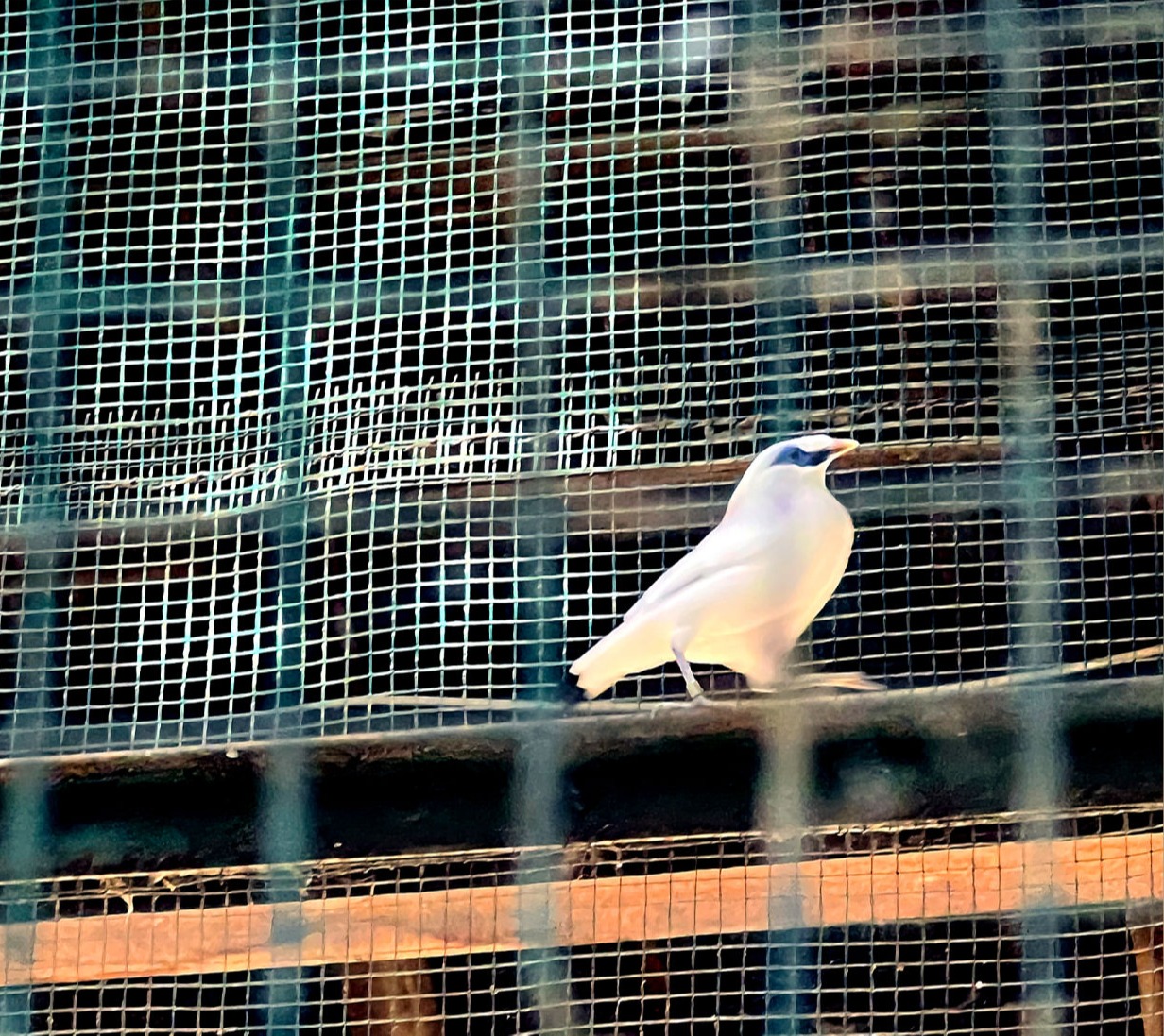
Gede also often quickly called our attention to distinct bird sounds or bird spots, as birds of course also abound here in the national park. He would hear their calls, then point to the direction of kingfishers, or to the nests of sunbirds. But the star of all the birds here would have to be the endangered Bali Starling, for which West Bali National Park was established in 1941 in the first place, according to Indonesia’s Ministry of Tourism, with the goal to help save these then nearly-extinct birds. While the park is reported to be the home of about 160 species of birds, the Bali Starling is the island’s only endemic vertebrate species, the Ministry states, and is thus the iconic bird of Bali. Gede soon led us to the national park’s Bali Starling sanctuary—after we had feasted on our picnic breakfast, and where I had my veggie omelet, village-style hash browns, and croissants and coffee. I’ll now skip sharing some of my companions’ jungle picnic quirks because what follows, monogamous birds, is far more interesting.

At the Bali Starling sanctuary, we were able to observe these lovely white birds a little bit more closely. And we were extremely amused by some of their human-like traits. For one, we’ve been informed that the Bali Starling is a territorial bird, and is thus, as earlier mentioned, monogamous. They tend to have only one partner in their whole life. To me, that’s not just monogamous, that’s hopelessly romantic. A mommy-daddy pair shares in the task of raising its chicks, incubating and feeding the babies together as partners. But take this: if for some reason one partner departs, guess what? Gede said the one parent left throws its baby bird away. No kidding. You can say the Bali Starling is not exactly progressive by obviously not being pro-single-parenting.

Still, the Bali Starling’s record in terms of breeding and conservation has been improving slowly but surely. Gede said that since 2015, the sanctuary has released eight couples in the wild. Now, 10 babies are already being prepared to be released in the wild too, come rainy season. For now, the pairings in the sanctuary seem to be going on harmoniously, as we saw the lovebirds contently feasting on fruits and honey in between their smooching. While inside the sanctuary, Gede pointed out to us how among these birds, it’s actually the women who are aggressive and demonstrative in showing their urges to kiss and rub, while the men tend to be the vain ones and more attractive. Well, at least in that regard, the Bali Starling girls are progressive. 

Mobirise Website Builder

Bali Starling

There are numerous other notable animals in the park which Gede spoke to us about during our trek, a lot of which exhibit behavior that amusingly show wit, because it’s also true in the animal world that you need to wise up to survive. There’s the squirrel who builds nest after nest after nest, as many trick nests as it possibly can, to mislead predators and keep her baby squirrels safe. Gede was so intent that I see each one that he points to, but with the glare when one looks up, I just can’t spot them from the trees. I had to finally just ask him to take a photo and zoom it in for me, just so this coffee-craving trekker can proceed to the picnic. There’s also the ghost crab which we should not eat if we don’t want to die, Gede said, because it consumes waste and extreme amounts of heavy metals. No problem with that, Gede, I just want my Bali coffee. And finally there’s the monkeys of the park, which Gede classified under two kinds. First, the black monkey, which he said can only be seen after 7 kilometers into the path we’re taking, and since we were meant to only take 4.2, the black monkey would have to miss our company. Then second and lastly, there’s the grayish longtail monkey which is everywhere, inside the park and even in other localities of Bali.

Mobirise Website Builder

Top to bottom: the hearty jungle picnic breakfast prepared for us by Plataran Menjangan, the good ready chef to take our customized omelet orders, and the asianTraveler trekkers

This was a bit of a concern to me earlier in our trek, because they might join in on our jungle breakfast picnic, but Gede was quick to assure us that the spot where we would be eating won’t be a stomping ground of the longtail. Plus, the crew handling our food carried slingshot props with them to scare off the mischievous creatures who scram when the human would pose as if to take aim. No problem at all with me then, because I really do take my guides’ words on these flora and fauna matters. Just as I took what our Bali guide Artana said, during the previous night when he dropped us off at the resort and one of my senior companions was worrying about the presence of snakes in this national park, because it’s where the resort is. Of course Artana did not deny that there are lots of snakes in the park, as in any other massive park like it, but he also assured us, followed by my instant reactions:

“Actually the case for snake bites in Bali is way smaller. [Fewer] people have been killed by snakes compared to those killed by falling coconuts.”

“Whoaaaaa! Okaaaaay...”

“And everybody thinks that coconut is good, healthy—yes it is! But look, more people are killed actually by a falling coconut than by a snake bite.”

“That’s not a joke, right?”

“No.”

So, yeah, the animals shouldn’t be a cause for concern—it’s our human ignorance we should worry about. The West Bali National Park after all is their home, their housemates are the fair flora, and we’re only their clueless guests. I could probably harm myself more by scalding my throat with the picnic coffee I’ve been thirsting to chug on, while a mischievous little national park longtail sneers at me from a tree, basking in the Bali sun, savoring the early morning dew. 

Mobirise Website Builder

Mangroves grow richly within the national park.

Subscribe to us

Exclusive offers in your inbox

Mobirise.com