Two reasons reigned over me in looking forward to going to Yogyakarta in central Java. First, the train ride from Surabaya to Yogyakarta via the Sancaka Express, which I expected would afford me a unique view of the Javanese countryside, plus it would tick off my bucket list a longstanding dream of embarking on a scenic road trip via train. True enough, I had exactly that – four hours of rolling farmlands and townscapes right before my eyes. I was too amazed I did not even get to nap.
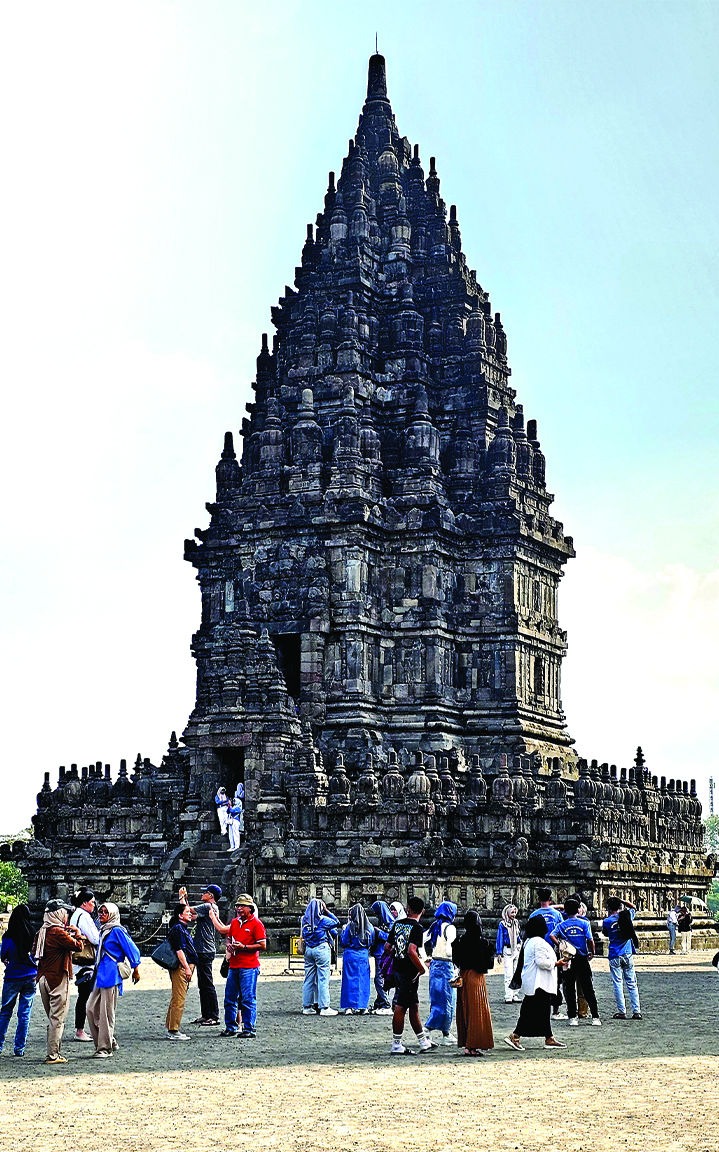
The other reason, and the more important one, this entire journey's raison d'etre – Prambanan. Yes, that 9th century Hindu temple complex, the largest in Indonesia, the second largest in Southeast Asia after Angkor Wat of Cambodia, and one of the largest in the world. That one which was originally composed of 240 temples, most of which lie in ruins surrounding its bigger temples, all 390 square meters of it tracing the layout of a mandala. That masterpiece of classical Hindu architecture, declared in 1991 by UNESCO as a World Heritage Site.
There—mandatory facts and figures over and done with. Good, because as I would learn very soon, as much as all these trivia are important, they mean nothing when one is finally faced with the glory of Prambanan. In the most life-affirming way, I never felt so little in my whole life.
As soon as I saw the temple complex from a distance, I could already feel tears welling up. If I could have my way, I just wanted to sit still and stare. But we had to keep walking, and the closer I came to the inner zone where the Trimurti temples stand, I could not bear looking away even for a second to grab pen and paper. I felt as if the gods were compelling me to keep my head up and keep my gaze on their temples, these expressions of their sanctity, for every second that I was there. At one point I had to ask my guide Ignatius if may touch a block of one of the numerous piles of ruins surrounding the temples, and when he said I may, I ran my fingers and palms across the circular carvings on it. This was the only moment I had of focusing on the carvings, because as we approached the temples even closer, it has been their astounding dimensions that had me open-mouthedly transfixed.
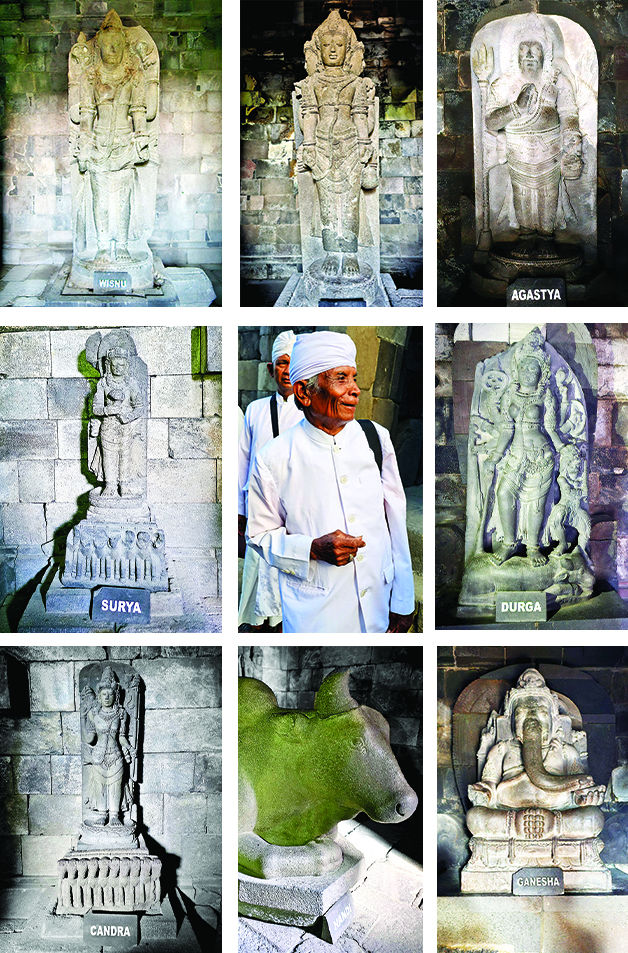
Three Trimurti temples stand at the center of the inner zone, each representing the three gods: Shiva, the destroyer; Brahma, the creator; and Vishnu, the preserver. Shiva's temple dominates the landscape, being the biggest and middle temple, flanked by Brahma's on its south side and Vishnu's on its north side. I climbed each of the three temples and stood at the foot of the gods' statues in the temples' chambers. The chambers are lit only by natural daylight coming from the singular narrow entrances. As much as I wanted to linger, I had to give way to others also wanting a view, so I swiftly moved from one temple and one chamber to the next. Going out of and down the temples were even more challenging than climbing, so extra care must be taken by travelers and pilgrims.
Facing those three main temples are three more temples called vahana or vehicle temples, housing the statues of each god's servant vehicles: Nandi, the bull for Shiva; Hamsa, the sacred swan for Brahma; and Garuda, the kite for Vishnu. After a pause from our climb down the Nandi temple, Ignatius led us to a path with even more scenic views of the temples from the back, with more ruins of the surrounding Pervara temples in the foreground.
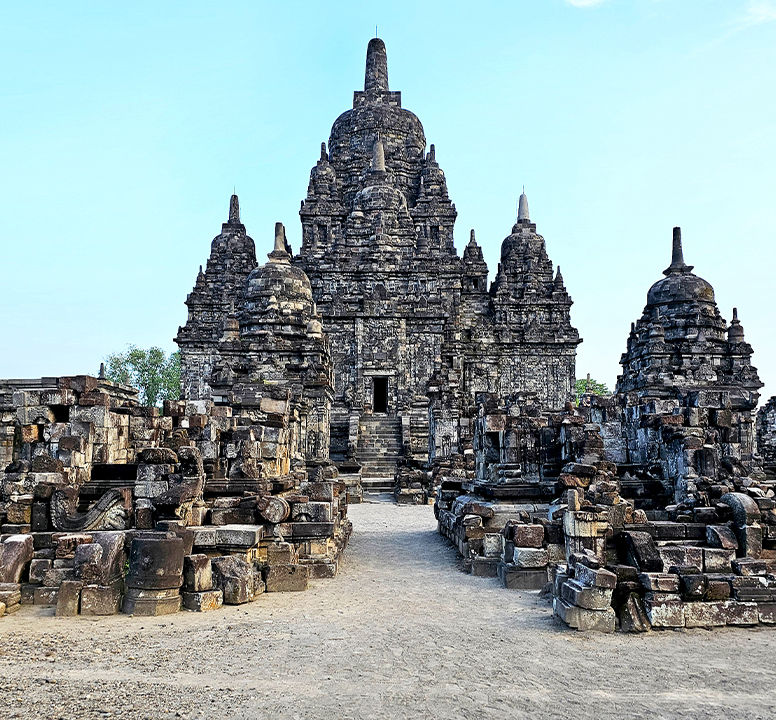
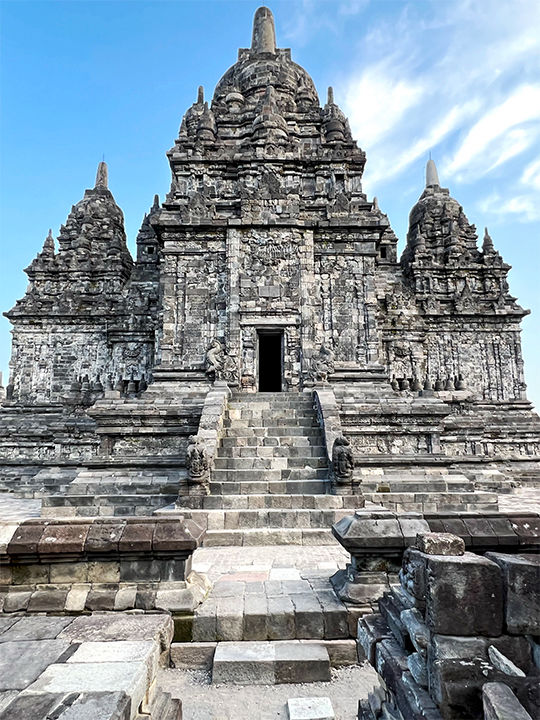
I felt a slight pang as I realized we were already heading out of Prambanan complex to ride a buggy for a short drive to the nearby 8th century Buddhist temple of Sewu, which predates Prambanan. Sewu is the second largest Buddhist temple complex in Indonesia after Borobudur in nearby Magelang Regency, and predates Borobudur as well. And while Prambanan embodies the magnificence of Hindu architecture, Sewu's temples stand out as well, crowned by towering stupas. Sewu may be a Buddhist temple but it dwells too on Prambanan Plain, and just as with all the other ancient Hindu or Buddhist temples on that land, it shares in the glorious sacredness of the Prambanan temple complex.

While the holy relics of ancient Hindu and Buddhist temples draw in most of the world's travelers to Yogyakarta, we must remember that the Special Region of Yogyakarta is actually led by a sultan as governor and a duke as vice governor, making it the only diarchy within the government of Indonesia. The role and influence of the sultanate since the mid-1700s remain palpable, thus much of the rest of Yogyakarta's cultural attractions are in fact Muslim sites and part of the sultanate heritage. Ignatius took me and my companions to the three most important of these sites: the Kraton, Taman Sari, and Kotagede.
In the Kraton or the Royal Palace of Yogyakarta, built in 1756, Ignatius secured for me the assistance of a special guide, Ibu Amirul, who happens to be known around as a right hand to the popular and youngest daughter of the sultan, the progressive Gusti Kanjeng Ratu Bendara. Ibu Amirul graciously led us through the massive palace complex, made up of numerous joglo-roofed pavillions, with ornate Javenese pillars. Each huge pendopo serves a specific function, such as being the dining hall or living room hall, or music halls for the playing of specific instruments. For example, there is a separate hall for the playing of only western instruments, and Ignatius pointed out to me how the string ensemble depicted on the structure's colored glass denotes the function.
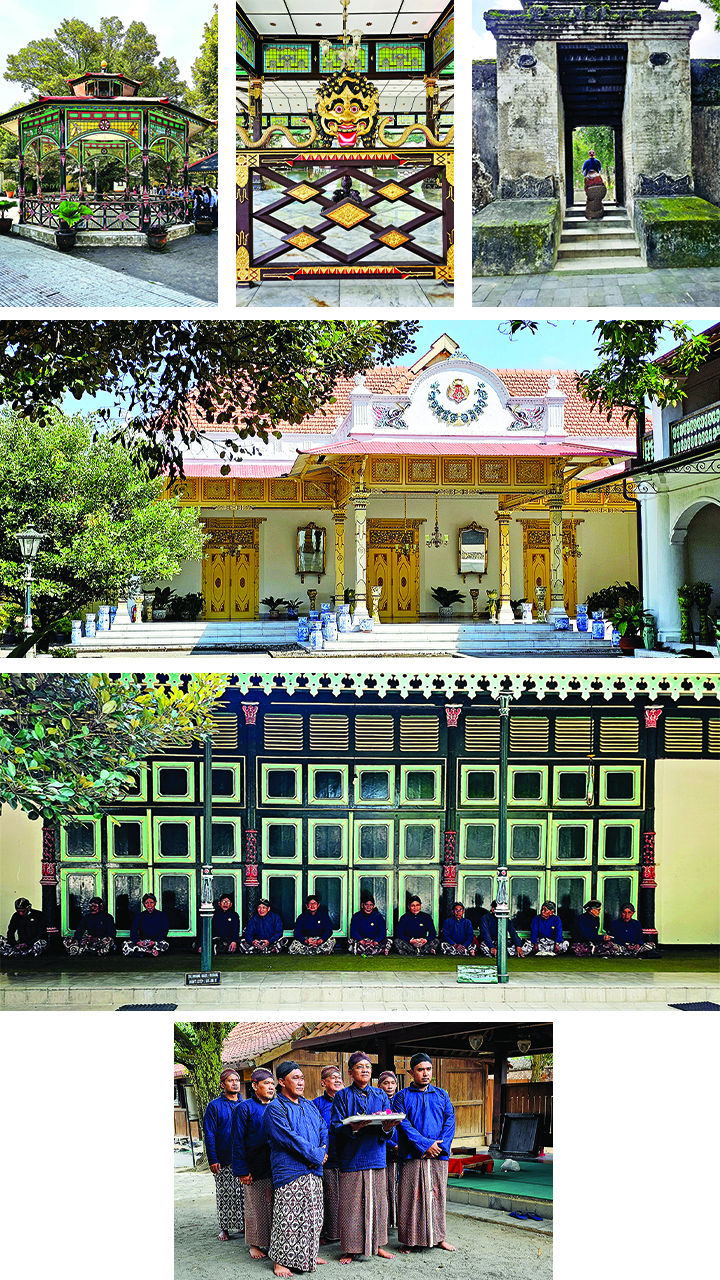
Overall, the structures also manifest the influence of Hindu and Buddhist elements, proving how the Kraton has been successful in preserving aspects of its roots. More importantly, the Kraton is the center of the village and remains to be the private residence of the sultanate, while housing active offices and exhibitions, and hosting royal ceremonies such as weddings, anniversaries, and coronations.
While Ibu Amirul had to stay within the Kraton, Ignatius continued to accompany me at the Taman Sari or Water Castle, a five-minute drive from the Kraton. Built as well in the mid-1700s, it still is part of Kraton land. Taman Sari's centerpiece is a bathing complex adorned by fountains that represent the lotus, another mark of Hindu-Buddhist influence. Taman Sari's old walls, with some parts in ruins and some being restored, remain off limits. This was not merely a place for leisure for the Muslim royals, Ignatius explained, but also a place of worship and meditation, and even a refuge or hiding place during times of conflict in its ancient years.
As our final point of royal exploration in Yogyakarta, we moved on to Kotagede, a suburb of Yogyakarta city and unmissable as it bears the remains of the Mataram sultanate, the last independent Javanese kingdom on the island before the Dutch colonization. During our visit, a group of Muslim Javanese pilgrims were about to enter the burial grounds to honor their ancestors. I and Ignatius, as well as the rest of our companions, are not the pilgrims' relatives, and of course cannot enter those grounds. But the gentlemen were so kind and allowed us to document via photos and video their procession, when they slowly walked towards the burial grounds holding trays of flower offerings, crossing whiffs of burning incense, the fragrance of which we all shared.


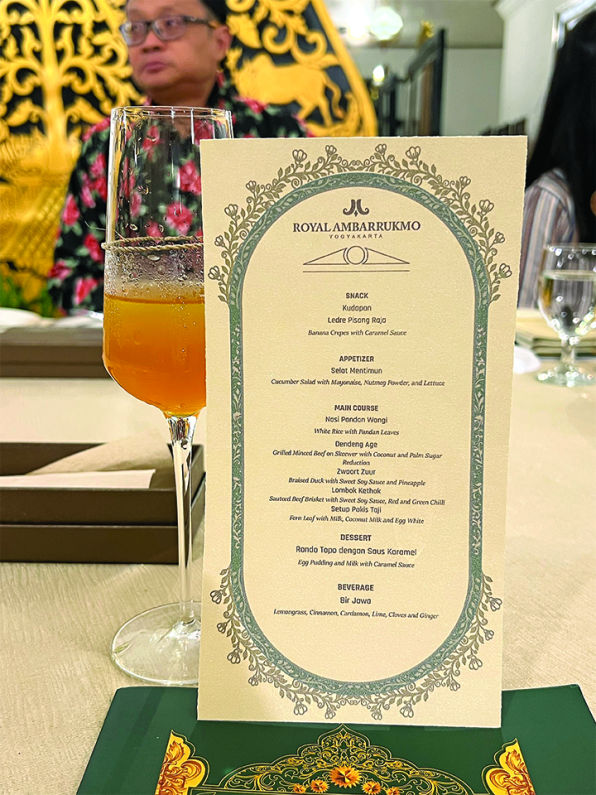

For those who seek something more on the side of leisurely fun like shopping and strolling, no worries, for all of Yogyakarta's magnificence, it still has got your basic cravings covered. In what has been described by travelers as one of Yogyakarta's hippest streets, Jalan Tirtodipuran, there lies Batik Winotosastro, a renowned local workshop for crafting authentic batik. Here I learned interesting things about the fine art of batik, as I watched the shop's veteran batik makers demonstrate their craft. One, that there are two kinds of batik, the handmade kind and the kind made from stamping. Two, that most patterns are of flora and fauna, and a popular animal pattern is that of Indonesia's revered garuda, which again has its Hindu roots. And lastly, when it comes to buying batik, those that bear more than two colors on the fabric are the least pricey, thus the more colors used, the more expensive it is. Our companion then offered to treat us, joking that we can only pick from the two-colored ones. I giddily rushed to the displays and chose my combo of yellow and white.
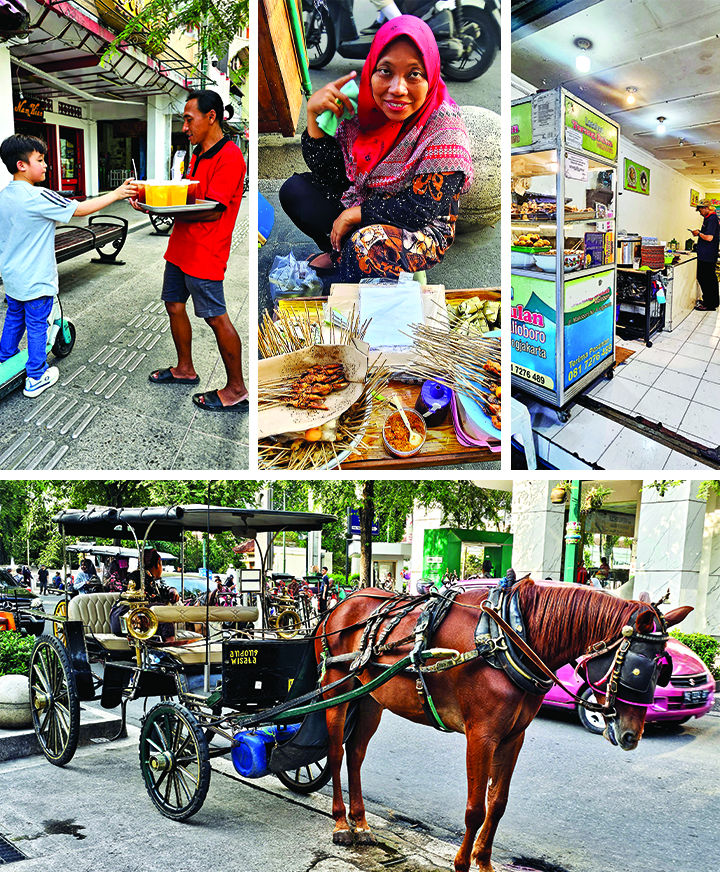
As our last Yogyakarta stop, we passed by the famous Jalan Malioboro, a one-way, one-kilometer street lined with shops, restaurants, and accommodations. It is motor vehicle-free, with no highrises out of respect for the Kraton. I chanced upon students gleefully giving donations to a busker. Lots of shops banner the word oleh-oleh, which means pasalubong. And the food halls with low tables serving local cuisine warung-style were so tempting. Jalan Malioboro might look like your typical melting pot, but actually, it is said to geographically form a straight north-south line from Mount Merapi to the Kraton, which aligns with what Ibu Amirul told me about the Javanese philosophical axis. This axis sees the Kraton facing Mount Merapi at the north, and has its back on the south where the Indian Ocean is. It has to do with the Javanese understanding of the cycles of life and their acceptance of it. This makes me recall some questions I asked Ignatius, who is not Hindu nor Buddhist nor Muslim, but rather a Catholic Javanese, and one who obviously treasures the many great gifts of Yogyakarta such as my unforgettable Prambanan.
While we were walking within the grounds of Prambanan, I had to point out to him the obvious – Merapi is an active volcano, and eruptions and earthquakes continually hound the restoration of Prambanan, as in fact the fatal 2006 Yogyakarta earthquake caused considerable damage. “That means the reconstructions never stop, right?” I asked him, and he answered, “Yes.” To this day reconstructions are ongoing, and there is no deadline, he said, they just do what they can at the moment. So I asked further, “Do you think you will ever get to see Prambanan fully restored in your lifetime?” He gave me the sweetest smile as he uttered, “No.” It may well be the smile of his fellow Javanese, across all faiths, all of them one in their acceptance of each other and the unpredictable majesty of their common home.

Website Building Software