
For more than a century and a half, pilgrims from all corners of the globe flock to a hitherto quiet Occitane town in southwestern France to drink from and bathe in the waters that flow from a spring inside a sprawling sanctuary.
Hugging the foothills of the Pyrenees mountains, Lourdes is a charming settlement of small, cobblestoned streets and massive cathedrals that reach out to the sky like a prayer in stone. Perched on top of a hill, the imposing Chateau Fort dates back to the times of the Roman conquest and today houses ancient sculptures, quaint artifacts, and the town’s local art.
On the summit of Pic du Jur, one can view the whole town of Lourdes and the surrounding mountain range and valleys while enjoying the cool breeze that sweeps through the picturesque French countryside. A walking trail leads visitors to an observatory that offers a commanding view of Lourdes. At night, the big cross that marks Pic du Jur lights up to brighten the dark skies above the town, like a beacon that guides the faithful.
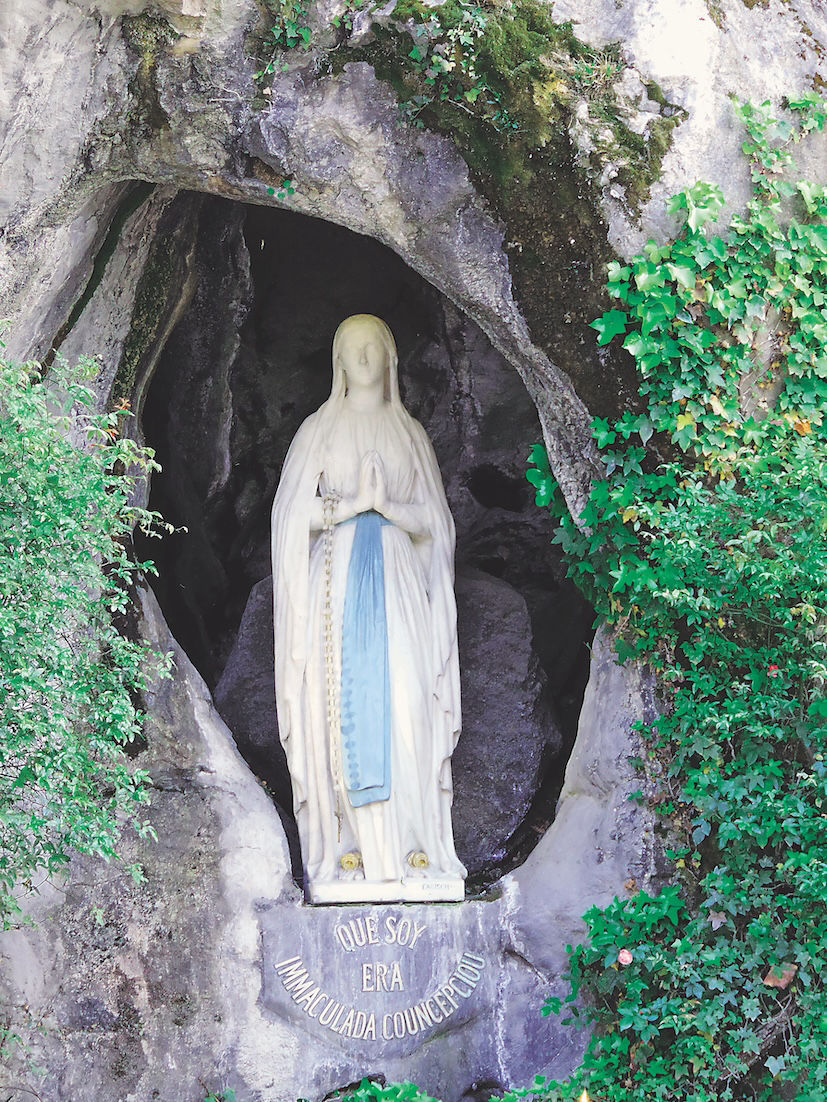
Running through the center of town is a river called Gave de Pau. Its swiftly running waters are born from the springs of Gavarnie and feed from the smaller rivers that flow from Barèges and Cauterets. On a land where the river passes rises a hunk of a massive ancient rock called Massabielle (from the French masse vieille, meaning “old mass”). Near the quiet riverbank, on the northern face of the rock, the wall curves inward to form a natural hollow—a grotto, if you will.
It was in this seemingly unexceptional cave where a young girl caught sight of an image so astounding that it changed the quiet town of Lourdes—and the rest of Christendom—forever.
Born on the 7th of January 1844, Bernadette Soubirous saw her first light of day inside the Boly Watermill where her father worked and her family lived. Growing up among the grindstones of the watermill and despite their humble existence, the family lived in harmony and contentment that the young Bernadette called her home “the happiness water-mill”.
By 1857, however, in the middle of a bitter winter, François Soubirous lost his job at the mill and his family fell into hardship. Without any means to secure a decent home, François moved his family to a dungeon, an ancient, one-room prison that was cold and gloomy. But their lives would take a dramatic turn the following year when the then 14-year-old Bernadette set out for the Massabielle cave to gather dry wood. At the grotto by the river, the Virgin Mary revealed herself to Bernadette in 18 apparitions.
The lady introduced herself as the Immaculate Conception and told the bewildered girl to drink and bathe from a spring. Dazed but obedient to the wishes of the lady, Bernadette promptly ploughed in the dirt until water flowed out of the ground.
Said to have healing powers, the spring soon lured the sick and the suffering. Soon, while unbelievers sought to have the grotto closed, the Vatican later confirmed Bernadette’s vision.
“When it was finally recognized by the Catholic Church, that’s when the pilgrimage really started. In 1866, when the train came to Lourdes from Paris, the pilgrimage to Lourdes became even bigger because pilgrims could come from anywhere by train,” tells Nathalie Jarraud, Marketing Director of the Lourdes Tourist Office.
Lourdes, once a sleepy, quiet town, became one of the world’s most-visited pilgrimage sites—attracting millions of people in search of a miracle and in pursuit of spiritual renewal.
A Sanctuary of Faith and Healing
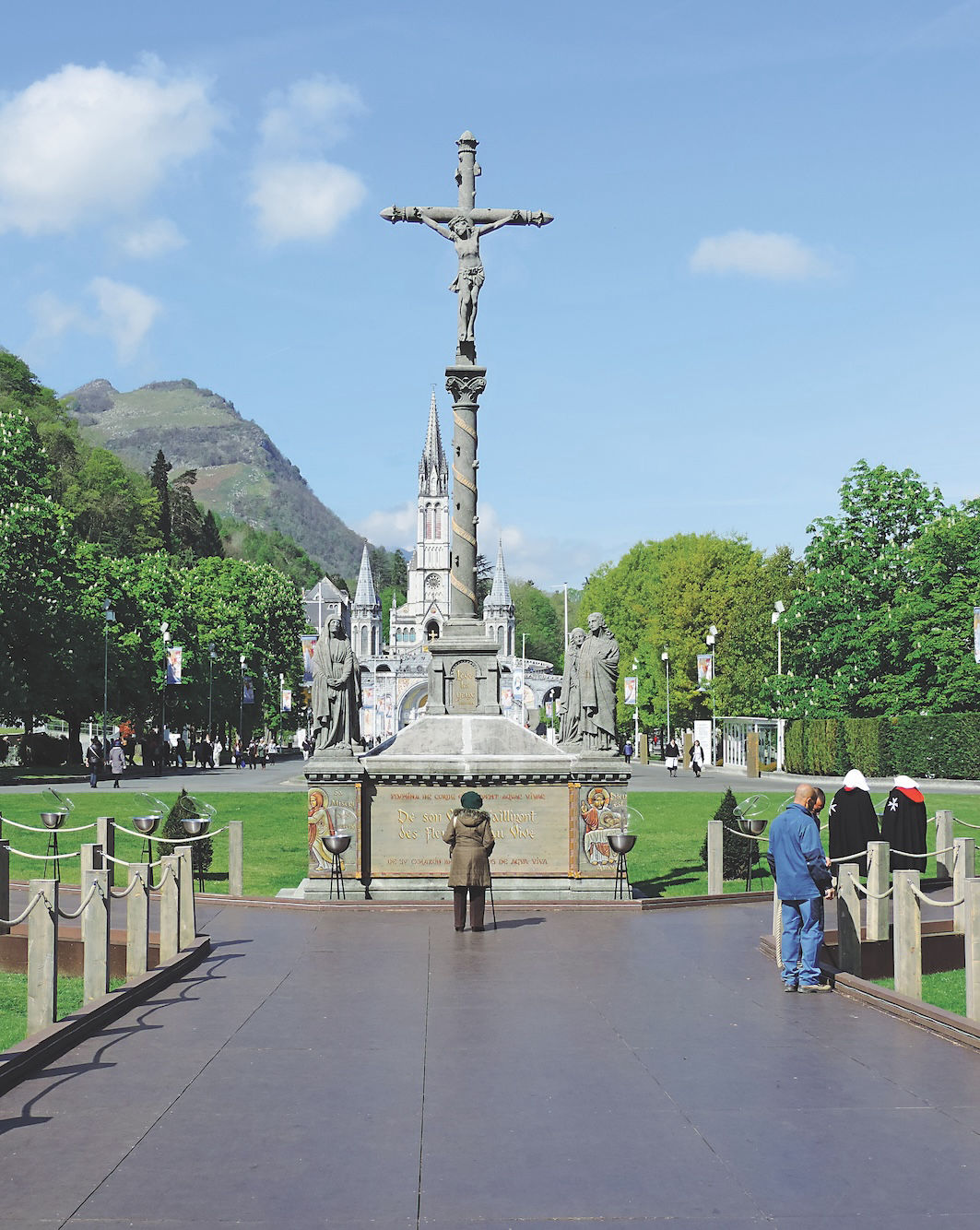
For decades since the apparition, Lourdes has been the spiritual keystone for the pious and the faithful from France and from all over the world. Today, the Sanctuary of Our Lady of Lourdes is a sprawling complex comprising 22 places of worship spread across an astounding 52 hectares.
Hewn out of the Rock of Massabielle, the Crypt was the first of the churches to be completed in response to the request of Our Lady in 13th manifestation to Bernadette. “Go and tell the priests to build a chapel here,” she instructed. Overlooking the entrance to the Crypt is a mosaic that depicts the image of Saint Pius X. A long corridor extends from here to direct visitors to a haven of silence and quiet prayer.
After the consecration of the Crypt, construction on the Basilica of the Immaculate Conception began. Also known as the Upper Basilica, it tells the story of the Virgin Mary—including the proclamation of the dogma of the Immaculate Conception by Pope Pius IX in 1854 and the Apparitions of Lourdes in 1858—through the beautiful stained glass windows.
Adding more places of worship of remarkable splendor has made the sanctuary as much of a tourist attraction as a true oasis of faith. Built in the Romano-Byzantine style, the Basilica of Our Lady of the Rosary features an impressive mosaic of the Immaculate Conception and the 15 Mysteries of the Rosary. Its impressive Venetian mosaic decorations make it a sanctuary of great beauty.
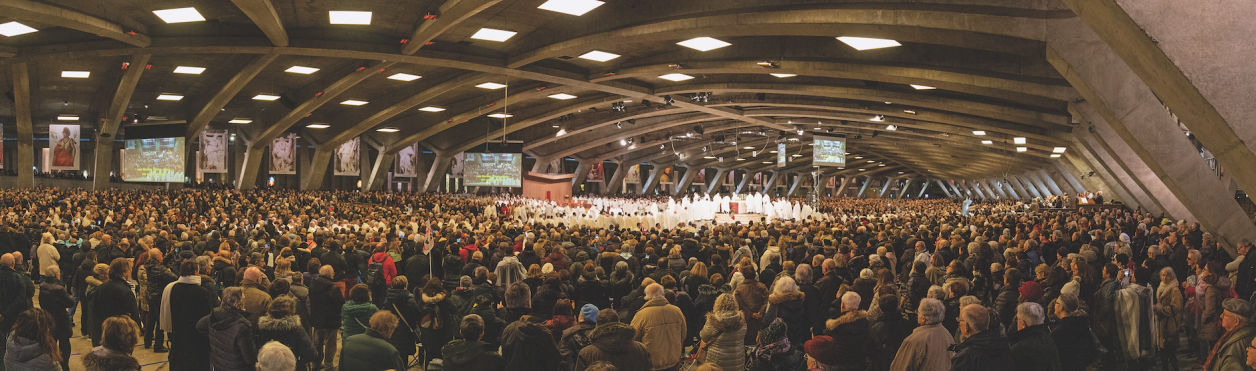
Perhaps, the most amazing architectural achievement within the sanctuary is the Basilica of Saint Pius X. Built underground, it is nonetheless colossal in size, covering a surface area of around 12,000 sqm with a shape resembling an overturned boat. The Basilica of Saint Pius X can accommodate 25,000 people at any one time, inspiring the faithful to connect with the divine through the lavish decorations of 39 paintings depicting various saints and blessed people, and 52 gemmaux (intricate glass artworks lighted from within).
The latest addition is the Church of Saint Bernadette, which was built to honor the humble and unassuming girl whose visions have inspired the creation of the sanctuary. Constructed on the spot where Bernadette stood when the lady first appeared to her on that fateful day in July, the modern church can hold 5,000 people and significantly faces the Grotto of Massabielle on the right bank of the Gave de Pau.
When Bernadette dug the spring at the Grotto of Massabielle as directed by the apparition of the lady, not a few doubted her account and ordered the grotto to be shut down. But once sanctioned by the Vatican, the spring and the waters that flowed from it became the heart of Lourdes itself.
Today, water from the spring is channeled into the baths within the sanctuary. The water, naturally cold at a temperature of around 12 °C (54 °F), goes to 17 separate cubicles—11 for women and 6 for men. For around a minute, the sick are immersed into the water, while prayers are being recited. To bolster their healing, the veneration of a nearby statue of the Virgin is also encouraged. Because around 350,000 visitors use the baths each year, the water is now constantly circulated and purified by irradiation.
Part of the water is also channeled into a cistern, and dispensed via a system of taps near the shrine. Pilgrims may drink from the taps or collect the water in bottles or other containers to take with them for family and friends who are unable to make the trip to Lourdes.

But does the water really have the power to rid the body of all sorts of illnesses? Sometime in 1958, Anselme Lacadé commissioned an analysis of the water from the spring. A professor from Toulouse determined that the water contained carbonic acid, carbonates of lime and magnesia, traces of iron, potassium and sodium, among other minerals, and was deemed safe to drink.
Jarraud gives her opinion on the water’s vaunted ability to heal. She says, “It’s just normal, really fresh water; it doesn’t have any special component. But what makes it special is the place where it comes from. When you go there, whether you have faith or not, you feel something different. At the baths, I felt something happened to me. At that moment, I felt I could do anything and that I was invincible. There’s something mystical in the atmosphere and the ambience that will make you believe that it can help.”
While it appears that the water from the spring that Bernadette dug behind the grotto is simply safe, pure, normal water, a committee was formed to pass judgement on whether the healings that take place in Lourdes are miracles. From 1947 when the International Medical Committee of Lourdes was founded to 2015, 69 cases had been recognized as miracles by the Roman Catholic Church.
Every night, under the darkening skies that descend upon the town of Lourdes, thousands light torches and candles to participate in the nighttime procession inside the sanctuary. They sing to the lady in 6 languages, praying for her intercession to renew their corporal health and reinforce their spiritual fortitude.

Offline Website Builder