Art, History, and Timeless Beauty in Paris
Paris works because it refuses to choose between preservation and innovation.
Paris works because it refuses to choose between preservation and innovation.
Paris in summer offers different pleasures than Paris during the holidays, but the city’s core appeal remains constant. While Christmas transforms the city with markets along the Champs-Élysées and lights strung through bare tree branches, a June visit reveals Paris at its most expansive: long daylight hours stretching into evening, gardens in full bloom, the possibility of lingering outdoors.
Both seasons have their advocates. Holiday visitors get festive window displays at Galeries Lafayette and the particular magic of walking through historic neighborhoods under December’s early darkness. Summer visitors get cafés spilling onto sidewalks and the luxury of wandering without coats.
The museums, churches, and monuments remain open year-round, indifferent to season, which makes Paris reliable as a destination regardless of when you arrive.
Inside the Bourse de Commerce that summer, the air-conditioned galleries provided relief from the heat outside, while the artworks themselves offered something else entirely: contemporary artists’ sharp observations of a world in flux.
Running from March through early September 2024, “Le monde comme il va” (The world as it goes) borrowed its title from Voltaire’s 1748 philosophical tale about human folly and social chaos. Curator Jean-Marie Gallais pulled together works from the 1980s onward, filling every level of François Pinault’s ambitious art space with pieces that refuse polite conversation.
Jeff Koons’ “Balloon Dog (Magenta)” greeted visitors with its mirror-polished surfaces, kitsch elevated to high art, or high art reduced to kitsch, depending on your perspective. The piece has become shorthand for contemporary art’s complicated relationship with commerce and spectacle, though seeing it alongside darker works in this exhibition stripped away some of its playfulness.
Anne Imhof’s installations demanded a different kind of attention. The German artist, who represented her country at the 2017 Venice Biennale, showed still lifes and a weathered punching bag that carried the weight of physical and psychological endurance. Imhof has built her reputation on works that examine power structures and bodily vulnerability, often using performance and duration to wear down viewers’ defenses.
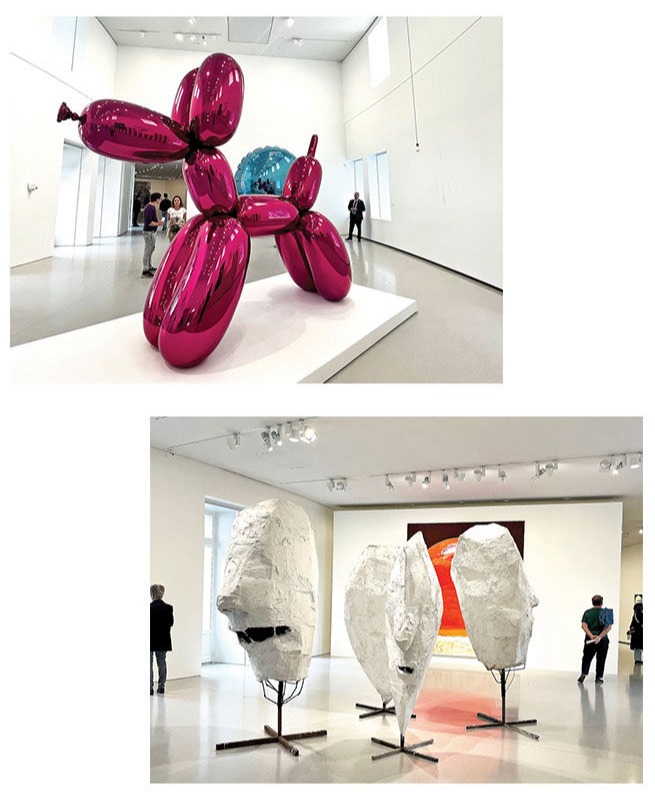
Top photo: Jeff Koons' Ballon Dog (Magenta) gleams inside the Bourse de Commerce, embodying contemporary art's interplay between spectacle, commerce, and critique. Bottom photo: Franz West installation from "Le monde comme il va".
Elaine Sturtevant’s “Duchamp 1200 Coal Bags” filled another gallery with its recreation of Marcel Duchamp’s 1938 intervention at the Exposition Internationale du Surréalisme. Sturtevant spent her career making exact copies of other artists’ works, raising questions about originality that the art world found deeply uncomfortable until they finally recognized her as a conceptual pioneer. She died in 2014, but her appropriation strategies predicted much of what followed in contemporary art’s ongoing crisis about authenticity and authorship.
The first floor held the exhibition’s most disturbing work. Sun Yuan and Peng Yu’s “Old People’s Home” from 2007 placed thirteen hyper-realistic figures in motorized wheelchairs that lurched forward periodically to bump into one another. The figures slumped in their seats, eyes closed or staring blankly, while their vehicles clattered across the floor in a grotesque mechanical ballet. What looked like a cruel joke about elderly care revealed itself as political satire, each figure precisely modeled after a contemporary head of state. The Chinese artists transformed a United Nations Security Council session into an old age home, their wheelchairs colliding without connection, their occupants beyond communication. The piece had shown at Paris’ Conciergerie in 2013, but in 2024, with its broader context of global dysfunction, it felt almost prophetic.
Cindy Sherman’s photographs added another layer of discomfort. For nearly five decades, Sherman has photographed herself in various costumes and contexts, creating images that probe how identity gets constructed, particularly for women. Her transformations consistently expose the artificiality of social roles. In an exhibition about how artists perceive chaos, Sherman’s investigation into the instability of the self provided crucial personal dimension to broader social critiques.
Maurizio Cattelan’s darkly comic sculptures, Bertrand Lavier’s investigations into representation, and younger voices like Pol Taburet filled out an exhibition that refused easy resolution.
The Bourse de Commerce represents only one piece of François Pinault’s larger art project in France. The French luxury goods billionaire opened the Palazzo Grassi in Venice in 2006, followed by the Punta della Dogana in 2009, both dedicated to showing his extensive contemporary art collection. The Paris venue, which opened in 2021 after Ando’s renovation, brought this ambition home to France. Pinault’s approach differs from traditional museum models—he’s not building encyclopedic collections but rather assembling works that interest him personally, creating exhibitions that reflect his particular vision of contemporary art’s role.
“Le monde comme il va” demonstrated this approach clearly. Rather than attempting comprehensive coverage of contemporary movements or checking boxes for important artists, Gallais selected works that spoke to each other across decades and mediums. The exhibition created conversations between pieces—Koons’ commercial optimism against Imhof’s austere critiques, Sherman’s identity investigations alongside Dumas’ unflinching portraits, the Chinese artists’ political satire near Sturtevant’s conceptual appropriations.
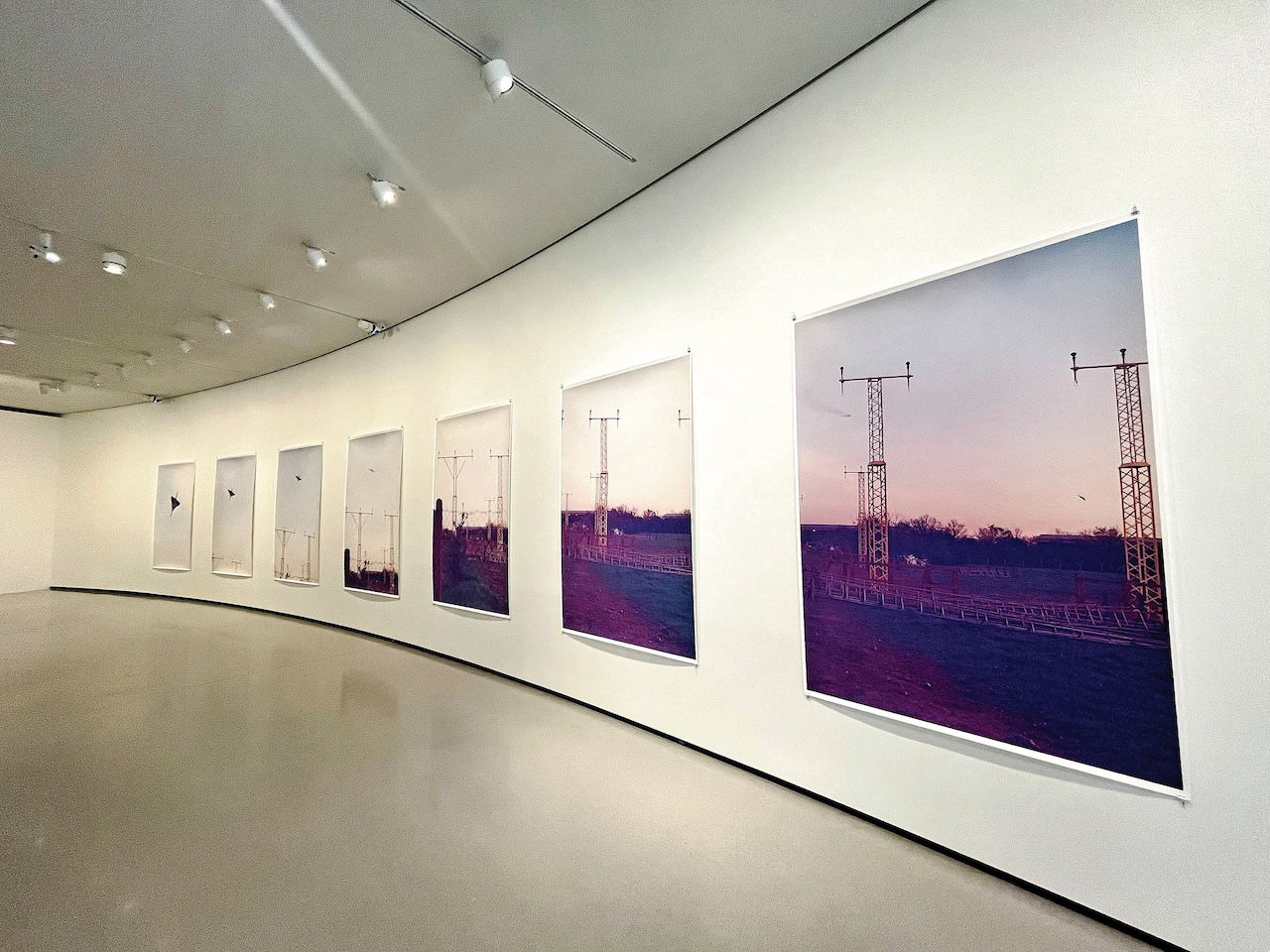
Exhibition spaces within the Pinault Collection showcase diverse contemporary voices, from photography to conceptual installations.
The Bourse de Commerce deserves attention beyond its role as a container. The building’s circular form dates to the 16th century, when it served as a grain market for the Medici family. Henri Blondel’s 1886 redesign added the iron-and-glass dome, Corinthian columns, and a magnificent mural depicting trade among five continents, a 19th-century fantasy of globalization that now reads as a historical curiosity.
When Tadao Ando took on the renovation, he inserted a nine-meter-high concrete cylinder inside the existing rotunda, creating a dramatic dialogue between minimalist modernism and ornate historical architecture. The concrete wall, austere and unadorned in Ando’s signature style, forces visitors to move between opposing aesthetic philosophies. Walking through the space means constantly navigating this tension between centuries and sensibilities.
For “Le monde comme il va,” Korean artist Kimsooja covered the rotunda floor with mirrors for her installation “To Breathe - Constellation.” Visitors crossing this reflective surface found themselves suspended between the painted dome above and its reflection below, their bodies temporarily part of an artwork about perspective and consciousness.
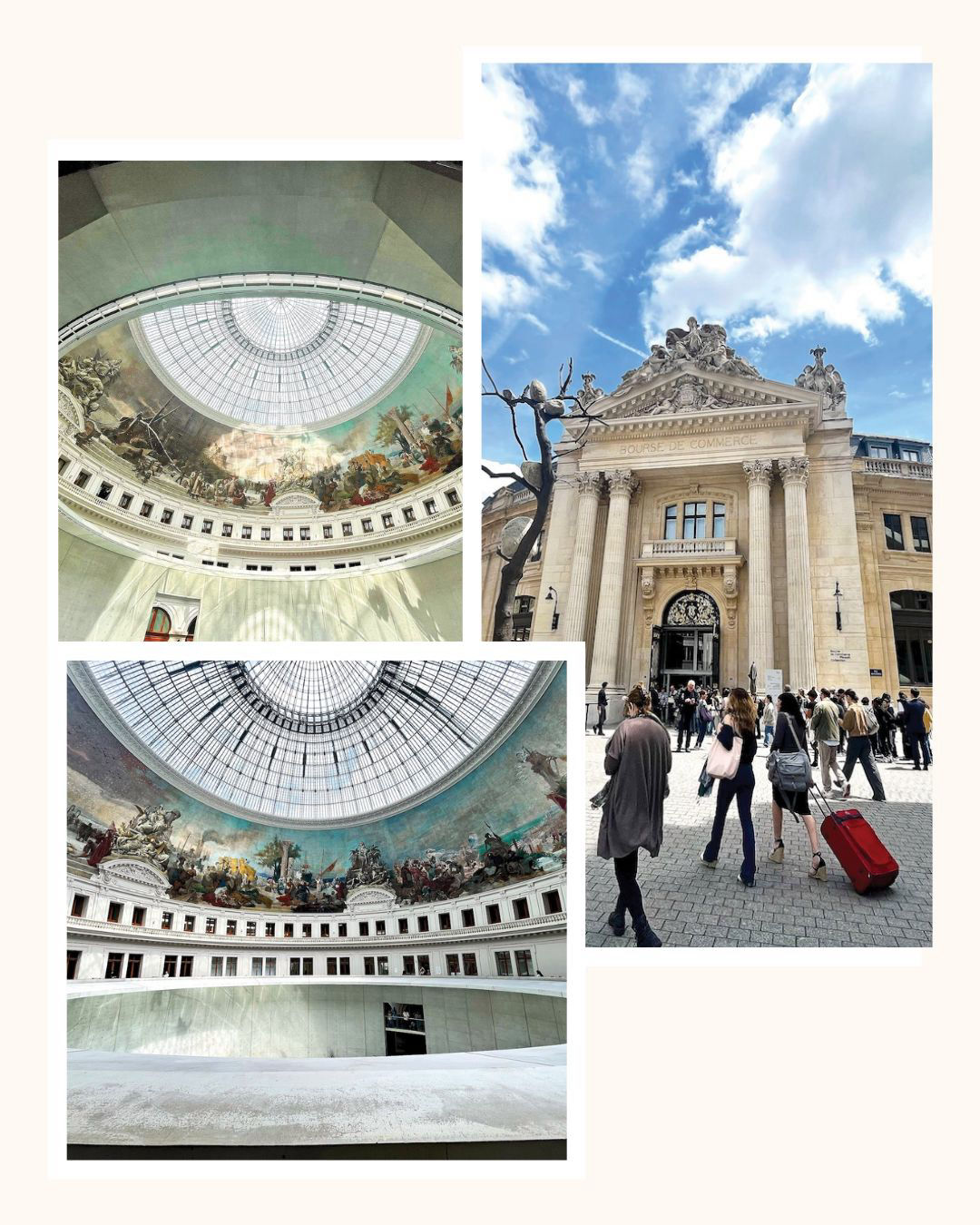
First photo, top left: The Bourse's grand dome, adorned with 19th century murals, reflects a vision of global trade beneath its sweeping glass canopy. Second photo, top right: The historic Bourse de Commerce, reimagined by Tadao Ando, stands as a striking fusion of Parisian heritage and modern architectural intervention. Bottom photo: Visitors move through Ando's minimalist concrete cylinder, where contemporary installations transforms the historic rotunda into an immersive experience.
After hours spent with contemporary art’s sharp edges, the Musée Rodin offered a different encounter, one grounded in bronze and marble. The museum occupies the 18th-century Hôtel Biron where Auguste Rodin lived and worked during his final years.
“The Kiss” stops people every time. Created in 1882, this white marble sculpture depicts Paolo and Francesca, doomed lovers from Dante’s Inferno, frozen in the instant before their lips meet. Rodin captures something technically astounding: the way marble can suggest both hardness and softness, both permanence and the fleeting nature of desire. The sculpture’s fame sometimes obscures its genuine achievement. Few works better demonstrate how sculpture can convey not just form but feeling, not just bodies but what happens between them.
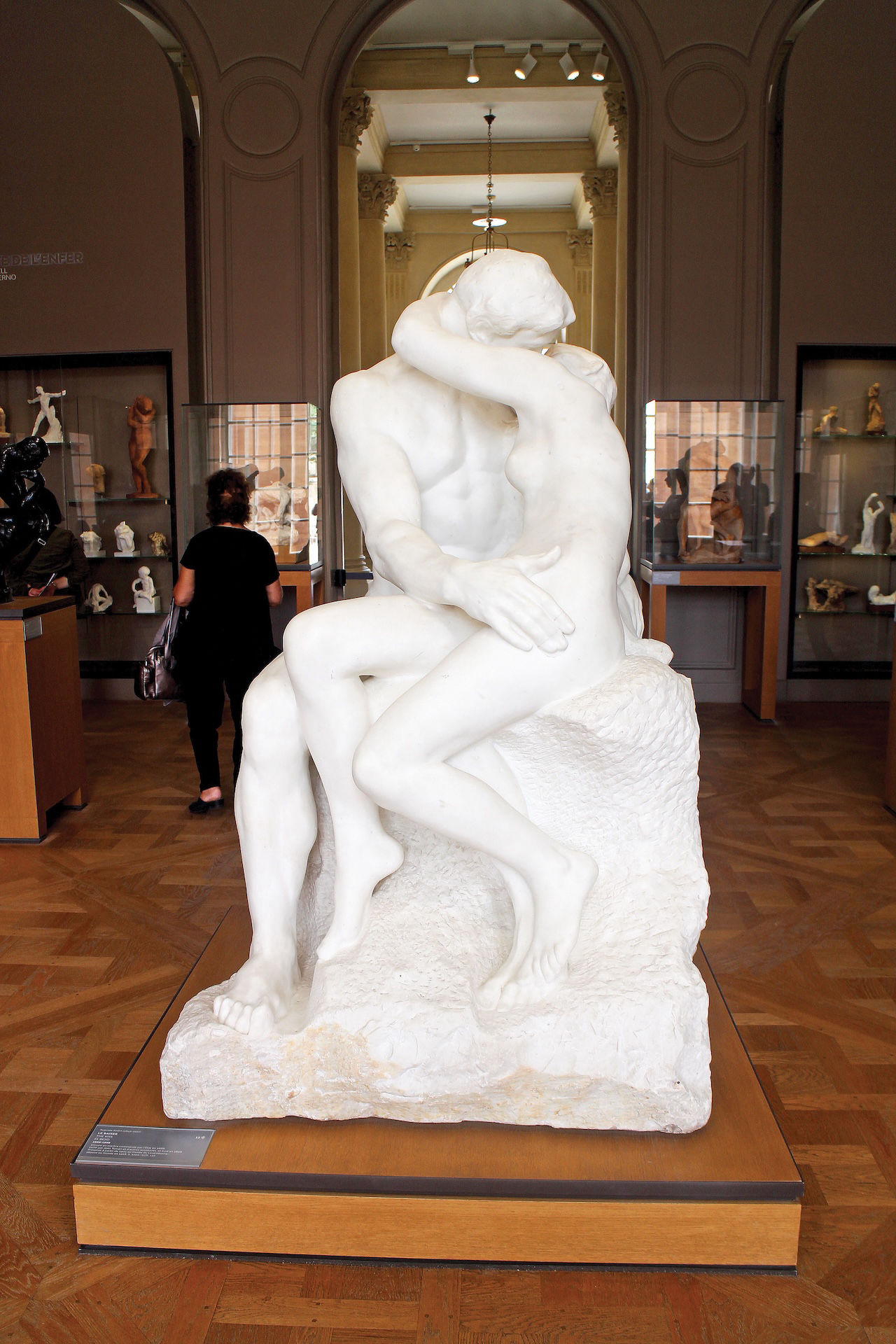
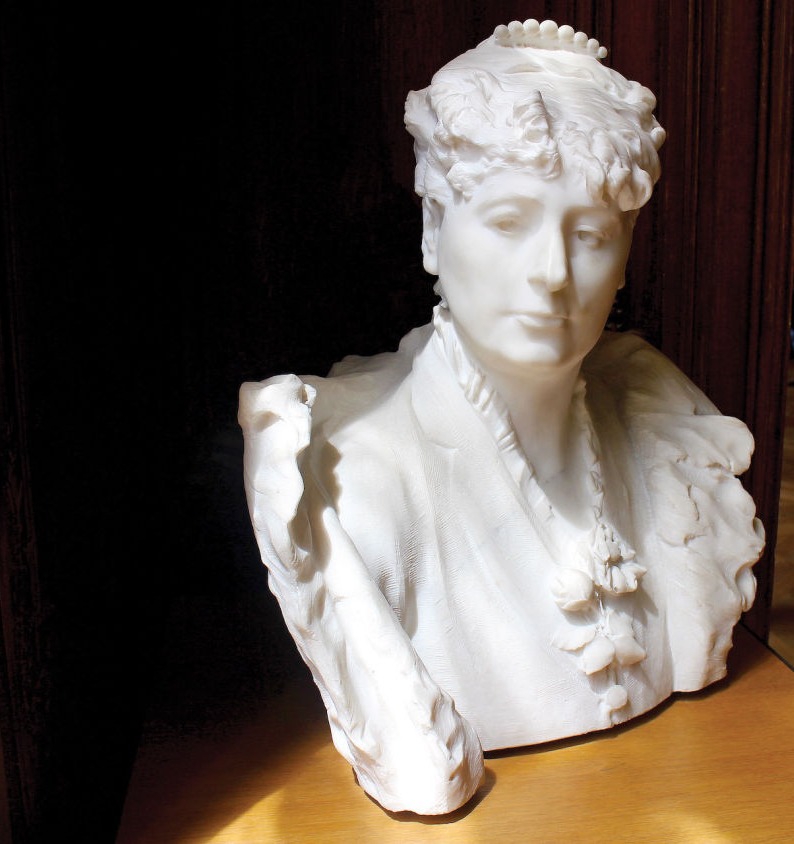
A masterpiece frozen in marble: Auguste Rodin's "The Kiss" (1888–1889) immortalizes the tragic romance of Francesca da Rimini and Paolo Malatesta, the star-crossed lovers from Dante's Divine Comedy.
The gardens, designed by landscape architect Jacques Sgard, wind around sculptures positioned to be seen from multiple angles and in changing light. Rose bushes frame pathways that lead to unexpected encounters with bronze figures. “The Gates of Hell”, Rodin’s monumental portal inspired by Dante’s Divine Comedy, which he worked on for 37 years without finishing, dominates one part. The writhing mass of figures served as source material for many of his most famous individual sculptures. “The Thinker” crouches in the garden, eternally brooding. “The Burghers of Calais” remain frozen in their moment of desperate courage, six men walking toward what they believe is their execution to save their city.
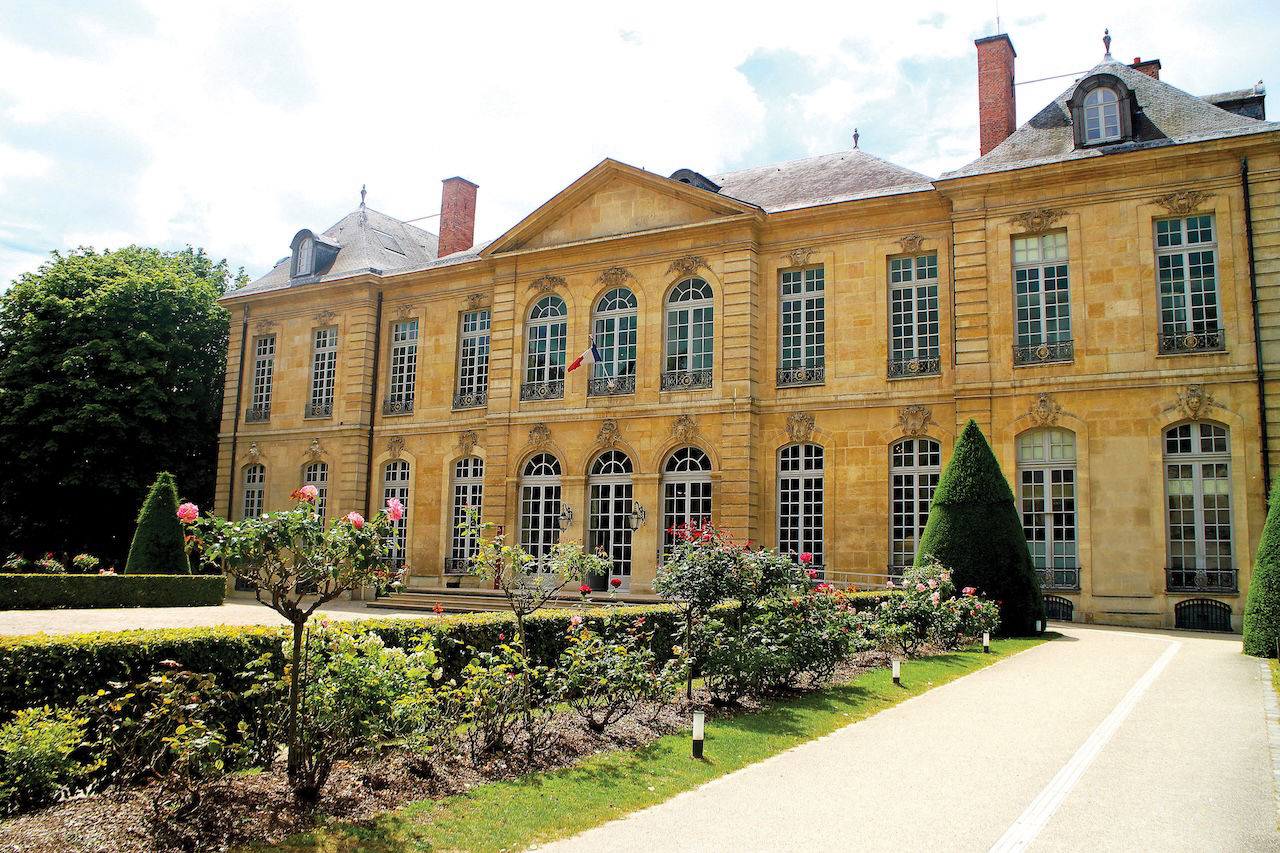
The Musée Rodin's serene gardens and the 18th-century mansion offer a tranquil setting where sculpture and nature coexist in harmony.
The museum rewards multiple visits because Rodin’s work operates on different frequencies. Sometimes the technical mastery dominates: the way he handles surfaces, the relationship between finished and unfinished areas, his understanding of how light plays across bronze. Other times the emotional content overwhelms everything else: the grief in his portrait sculptures, the erotic charge in his couples, the existential weight in his solitary figures. The work shifts depending on who’s looking and when.
The museum also pays tribute to Camille Claudel, whose sculptures can be found inside.
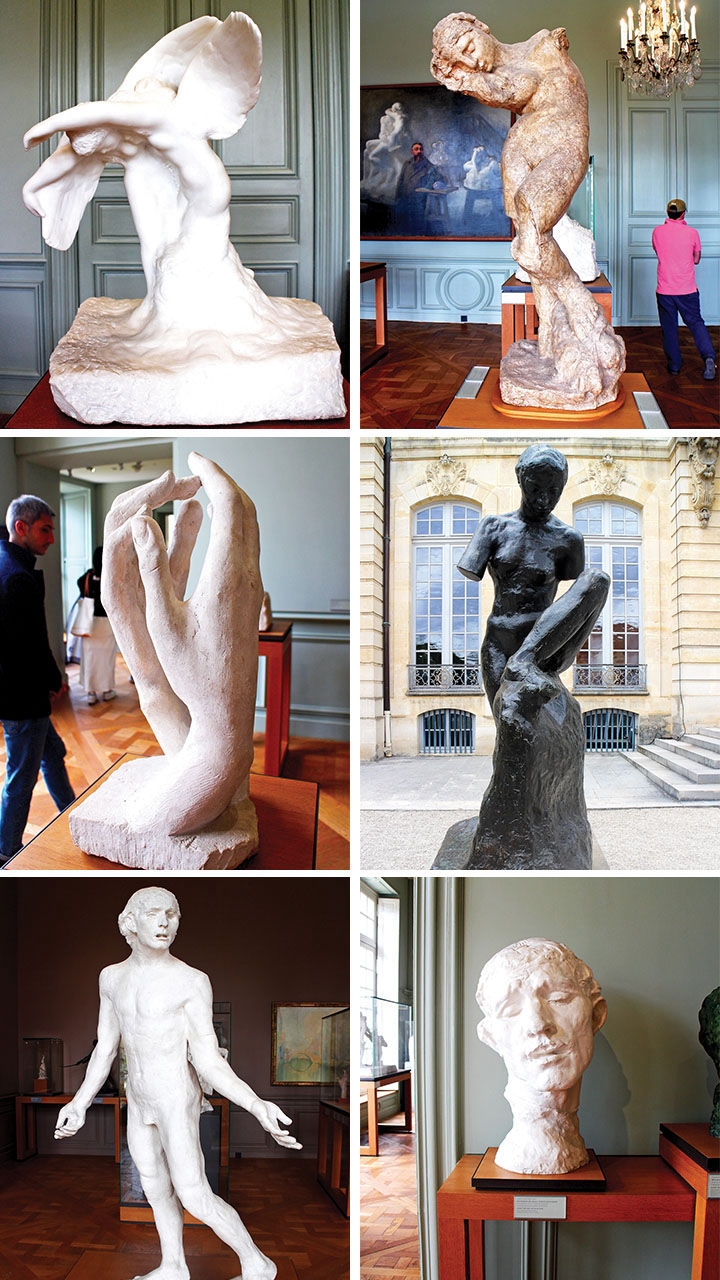
Masterpiece at the Rodin museum from expressive studies to monumental forms, reveal the emotional depth and physical dynamism of the human body.
Among Paris’ historic churches, Saint-Germain-des-Prés carries particular weight for anyone interested in intellectual history. René Descartes rests here, the 17th-century philosopher whose “I think, therefore, I am” helped establish the foundations of modern Western thought. His journey to this final resting place matched the complexity of his ideas. He died in Stockholm in 1650, was buried there, then sixteen years later French officials retrieved his remains for proper Catholic burial back home.
The church represents one of Paris’ most remarkable architectural survivors. Founded in 558 by Childebert I as part of a Benedictine abbey, it claims the title of the city’s oldest church. What visitors see reflects centuries of destruction and rebuilding. Vikings sacked the abbey four times before the structure was rebuilt between 990 and 1201. The nave preserves rare Romanesque architecture with massive stone columns and rounded arches, one of the few remaining examples of this style in Paris. The choir shows the transition to early Gothic design. Sixth-century pillars still support parts of the structure, silent witnesses to nearly fifteen centuries of history.
The church sits in dim, cool silence, its thick walls keeping out the noise from the surrounding Saint-Germain-des-Prés quarter. Colorful frescoes glow softly in filtered light. The neighborhood outside, famous now for its cafés and literary associations, grew up around the abbey’s protective walls. Le Bonaparte café sits directly across the square, its terrace offering views of the church’s facade while serving espresso to tourists and locals who probably don’t think much about the layers of history they’re sitting on.
The Palais Garnier operates on a completely different principle from the Bourse de Commerce’s dialogue between minimalism and ornament, or the Rodin Museum’s thoughtful restraint. Here, excess is the point. Charles Garnier designed the opera house as an embodiment of Second Empire ambition, completed in 1875 as a monument to France’s cultural supremacy. The building announces itself immediately in marble, gilt, sculpture, every surface claiming attention.
The grand staircase rises beneath a massive chandelier, red velvet and gold leaf creating an atmosphere of luxurious excess. The auditorium ceiling adds another layer of complication. Marc Chagall painted it in 1964, overlaying his dreamlike modernism onto Garnier’s 19th-century opulence. The addition proved controversial. Some found it jarring against the original gilded decor. Others appreciated the dialogue between eras. The six-ton chandelier below casts glittering light across the space regardless of opinions about what hangs above it.
Even for regular visitors, the building’s side rooms and corridors reveal new details, such as painted ceilings in the various foyers, sculptural groups flanking doorways, and the sheer quantity of decorative elements packed into every surface. Garnier and his army of artists apparently believed empty space was wasted space. The building functions as both monument and working theater, and witnessing a performance here adds dimension to understanding how architectural space shapes artistic experience.
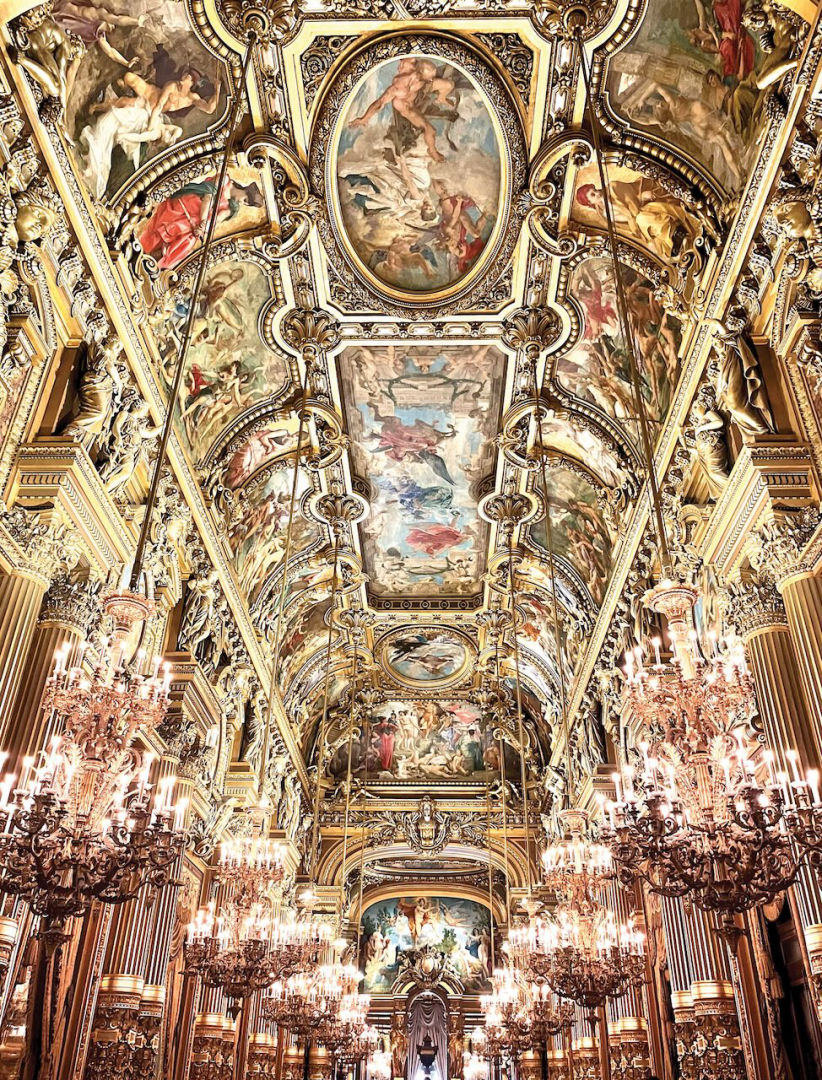
The opulent interiors of the Palais Garnier dazzle with gilded details, frecoed ceilings, and the grandeur of the 19th-century theatrical design.
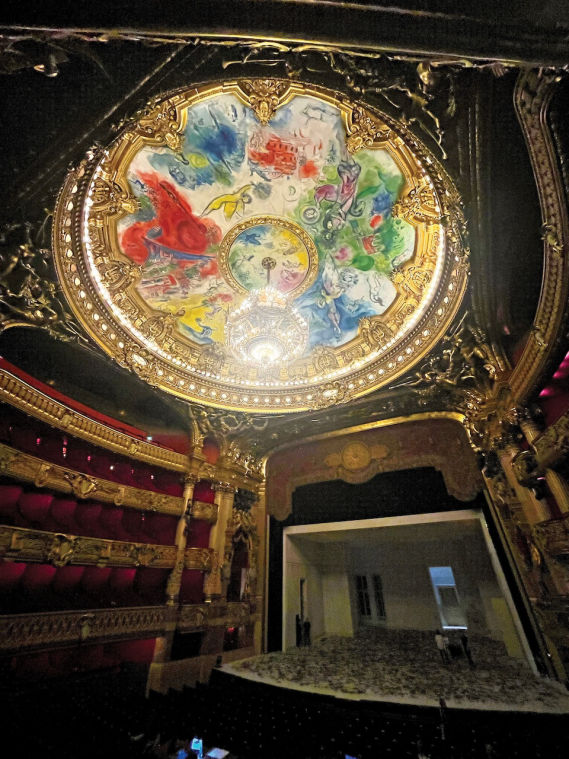
Marc Changall's vibrant ceiling painting crowns the opera house, blending modern artistry with Second Empire Opulence.
Walking between these sites — from the Bourse de Commerce’s contemporary confrontations to Rodin’s gardens, from Saint-Germain-des-Prés’s medieval stones to the Palais Garnier’s 19th-century excess — reveals Paris as a city built through accumulation rather than replacement. Other cities tear down and rebuild. Paris adds layers, preserves enough of each era to remain legible as history even while continuing to evolve.
The Jardin des Tuileries demonstrates this principle perfectly. Created by Catherine de’ Medici in 1564 as the garden for the Tuileries Palace, it opened to the public in 1667, making it one of the world’s first public parks. André Le Nôtre redesigned it in 1664, giving the garden its formal French layout in geometric paths, precise hedges, carefully positioned sculptures. The palace itself burned down in 1871, but the gardens remained, administered now by the Louvre Museum yet existing as their own entity, free and open year-round.
Walking through the Tuileries toward the Louvre provides one of Paris’ great architectural experiences. The view stretches from the Arc de Triomphe du Carrousel through the gardens to the Louvre’s central pavilion, the perfect axis of Le Nôtre’s design. The formal arrangement of trees and paths frames this vista, sculpture punctuating the green spaces. The Grand Carré section nearest the Louvre, designed to be admired from palace windows, still maintains its embroidery-like garden beds outlined by low boxwood hedges. On any given day, Parisians and tourists fill the metal chairs scattered throughout, reading, talking, watching children sail toy boats in the circular ponds, activities that would have been familiar to visitors three centuries ago.
The garden connects multiple eras and institutions – the Louvre, the Musée d’Orsay, the Jeu de Paume, Place de la Concorde – functioning as both thoroughfare and destination. Contemporary art installations appear periodically among the classical sculptures, temporary interventions in a space that has been reshaping itself for over four centuries while maintaining its essential character.
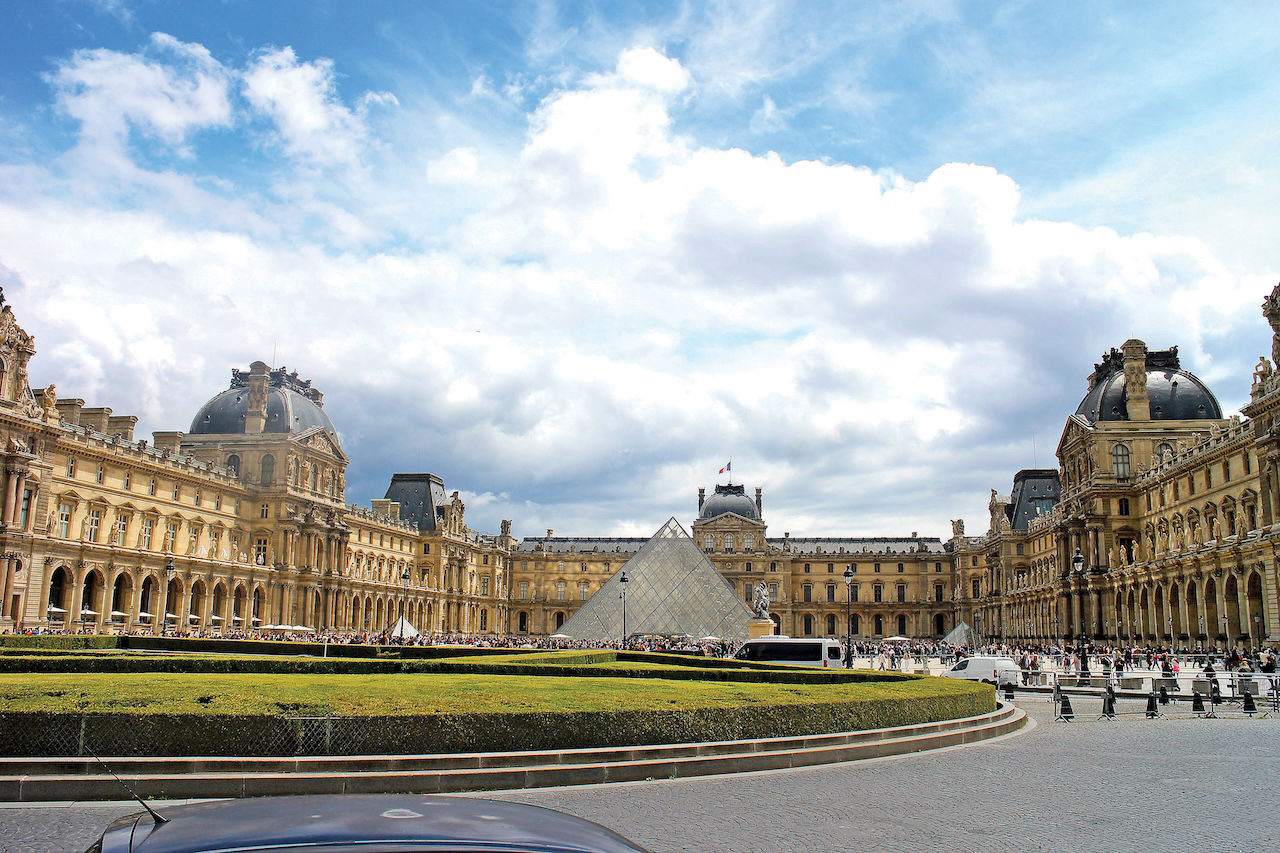
The Louvres' iconic glass pyramid rises within its historic courtyard, symbolizing Paris's seamless blend of past and present.
The tension between present crisis and accumulated history defines the experience of being in Paris. Artists keep making work about turbulent times because times are always turbulent. The Bourse de Commerce will host other exhibitions addressing other crises. The Rodin Museum’s gardens will continue offering their particular combination of beauty and melancholy. Saint-Germain-des-Prés will stand with its layers of reconstruction and its tomb housing a philosopher who tried to think his way to certainty. The Eiffel Tower will remain towering over the city, practical and iconic simultaneously.
What Paris offers, ultimately, is proof that cities and their cultural institutions can hold multiple truths at once: contemporary urgency and historical perspective, innovation and preservation, the moment’s chaos and accumulated beauty. Summer 2024, with Sun Yuan and Peng Yu’s world leaders bumping their wheelchairs against each other in mechanical futility, with Sherman’s identity investigations and Imhof’s austere confrontations, felt particularly sharp. But the sharpness exists against a backdrop of centuries, which doesn’t diminish the urgency but does provide context for understanding that humans have always been trying to figure out the world, and Paris has always been a place where that work happens.

Mobirise