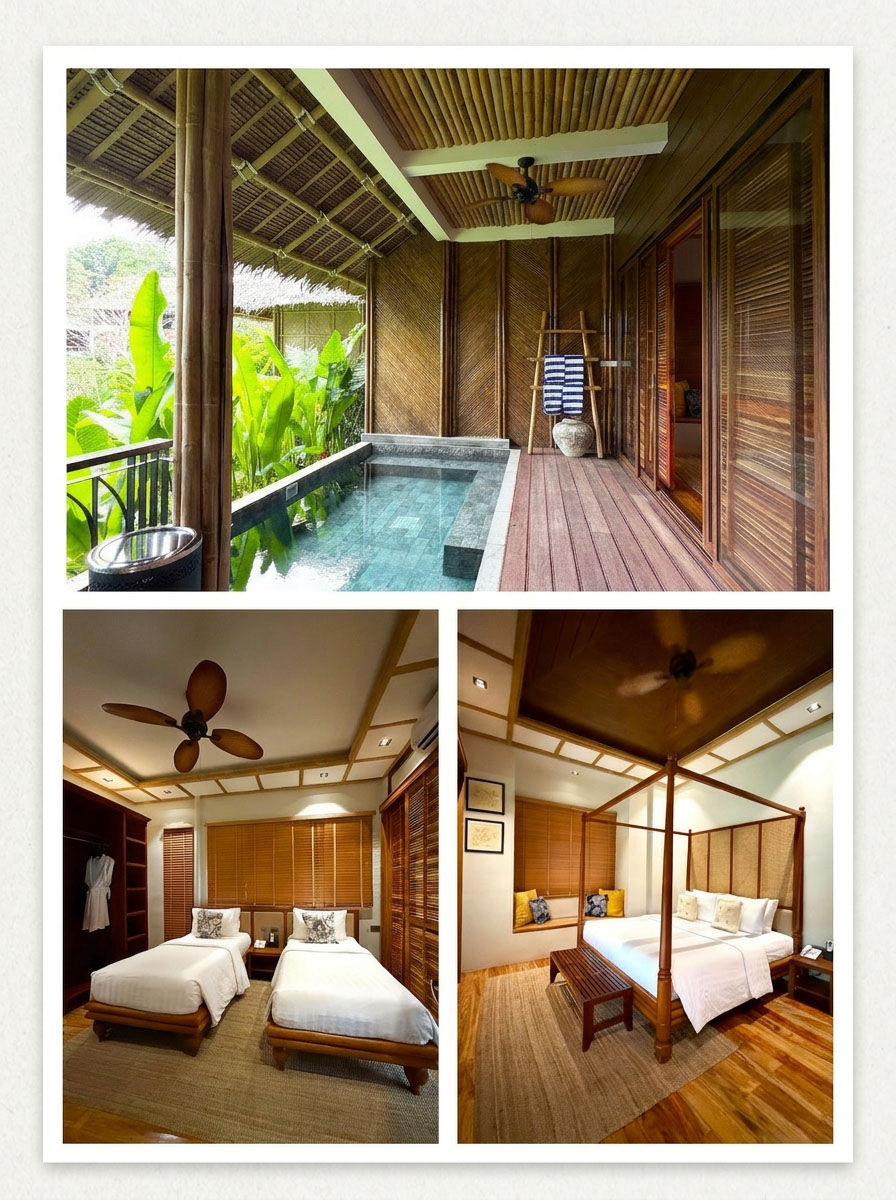
The rooms at Damires Hills Farm & Spa Resort are veritable cocoon of luxury.
Tucked between the verdant rice paddies
and the quiet hills of Janiuay,
Damires Hills Farm & Spa Resort
is a portal that leads to
serenity and allure of nature.
Slipping off the main road in Janiuay, the world seems to lean back. The turn-off is a narrow lane flanked by trees whose branches rustle in the late-morning breeze. The asphalt gives way to a soft, gravel-kissed path that winds up a forty-hectare hill, and there, cradled in the green, is Damires Hills Farm & Spa Resort.
After a very early morning flight from Manila, my room at the resort feels like a warm invitation. Like all of the resort’s well-appointed accommodations, the interiors are an ode to wood—polished floorboards that softly echo underfoot, shutters that frame the view like picture frames, low-profile furniture that seems pulled from a quiet living room rather than a resort brochure. The beds are dressed in high-thread-count linens that feel like a gentle hug.
Here, each room is a quiet study in how hospitality can be both refined and rooted. The Heliconia Deluxe is a modest haven: warm wooden flooring leads to a private balcony where shutters can be thrown open to let the forest’s perfume drift inside.
A step up, the Heliconia Premier offers an extra slice of the hillside. A low, upholstered sofa and a hardwood coffee table create a space for my quiet morning coffee, the steam rising and mingling with the scent of earth.
The Premier Suite feels to me like the hill’s own living room. A king-size bed with a carved wooden frame, plush couches, and floor-to-ceiling shutters pull the forest into the room. The balcony offers uninterrupted panoramas of forest, fields, and sky. An entertainment wall is there, but the real show is outside.
Tucked on a hillside, the family rooms—Mangga, Durian, Badiang, Langka, Bugnay, Chico—are designed like homes you could stay in for a weekend. A lofted sleeping area reachable by a sleek wooden ladder, a ground-level terrace with a small outdoor set, and enough space for four to six guests. From the shutters, you can hear the distant call of birds and see the hills roll away into the horizon.
The Narra Villas are the crown. Each villa feels like an old hacienda reimagined for today. A private dipping pool sits just beyond a balcony, edged with natural stone and tropical foliage, where the water seems to mirror the sky more than the earth.
The rooms at Damires Hills Farm & Spa Resort are veritable cocoon of luxury.
“The aesthetic thread that runs through all of this is unmistakably Filipino,” informs the resort’s vice president for operations, the boyish Atty. Luis Miguel “Miko” Tirador.
He continues, “Architect Gardo de la Cruz, an Ilonggo himself, uses mahogany, narra, bamboo, and stained-glass motifs in the design. The fixtures bear ornamental patterns that recall the intricate woodwork of a classic bahay na bato, while the modern comforts feel almost invisible against that backdrop.”
A lawyer by profession, he oversees every facet of operations at Damires Hills Farm & Spa Resort—from guest-facing services such as front office, housekeeping, food and beverage, kitchen, and sales—to the behind-the-scenes logistics that keep the property running smoothly.
Adventure, Tirador adds, is the other heartbeat of Damires. A 500-meter zipline stretches over two towers—370 meters and 180 meters—allowing riders to glide in a seated pose or, for the bravest, “Superman” style, feeling the canopy rush past.
The canopy walk, a 217-meter hanging bridge suspended 26 meters high, offers a panoramic stroll above the treeline and over the rice fields where the chorus of native and migratory birds is a constant companion.
For hardcore adrenaline junkies who prefer to keep their feet on the ground, a 15-minute ATV circuit skirts the base of the hills and circles the rice fields, while the motor’s rumble mixes with the rustle of stalks.
Those inclined to spend the day in languid waters enjoy a dip or lap in the resort’s 300-square-meter infinity pool that spills over a view of the forested slope, its surface catching the sky and turning it a soft, liquid turquoise. Two smaller pools nestle among native trees, hidden like secret wells.
b
On a quiet early morning, the soft murmur of the water creates a symphony with the sounds of the surrounding woodland—birds calling, leaves rustling, and the buzz of insects singing a paean to the sun.
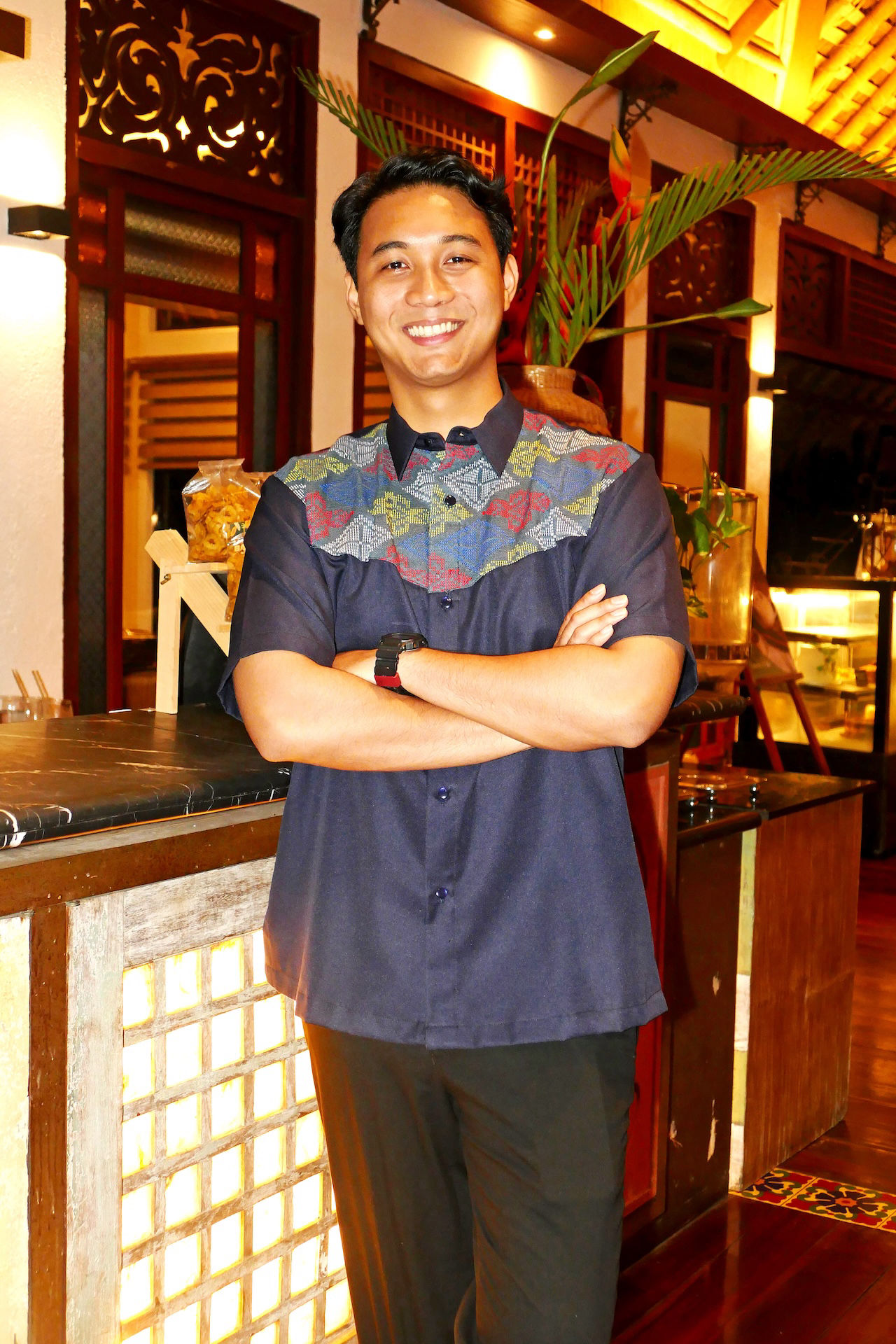
The resort's VP of Operations, Atty. Luis Miguel Tinador.
On a quiet lane lined by trees, a house sits under the shade like a remnant of a provincial bahay kubo. At Damires Hills Farm & Spa Resort, wellness is anchored by the Ilaya Spa, a Filipino-style sanctuary that offers a complimentary thirty-minute massage for overnight guests.
The therapists employ techniques that honor local therapeutic traditions, using oils derived from the very plants that grow on the estate. The centerpiece of the service is the hilot, designed by the resort’s Spa & Wellness Director, Atho dela Cruz.
While traditional Filipino hilot uses oil, much like Swedish massage, the philosophy differs. In the province, dela Cruz explains, healing rituals intertwine with daily life: pregnant women undergo tuob, a steam treatment of the private area; feverish patients have tuba-tuba leaves placed on their forehead; after harvest, farmers wash their hands with pomelo leaves to cleanse soil-borne germs. He adapts these customs into a spa protocol called Hilot sa Ilaya, which feels both familiar and novel.
“In Hilot sa Ilaya, a client begins by washing his hands with pomelo-infused water—a nod to the farmer’s ritual. He then goes inside the room where his feet are soaked in a basin of guava leaves, calamansi extract, salt, and agdaw (a local herb), which together cleanse bacteria, disperse negative energy, and soothe nerves.
Next comes hingut-an, a head and shoulder massage inspired by the provincial practice of removing lice from the hair and scalp. The therapist concludes with a full hilot massage, finishing by placing tuba-tuba leaves on the back,” dela Cruz describes.
All the therapies at Ilaya Spa are rooted in Filipino terminology: Lughud (hot stone treatment), Ma-anyag (beauty facial), Lutay (gentle pressure massage), Rutay (hard pressure massage), Kahig (foot massage), and Sik Sikan (shoulder and back massage).
“By branding our services in the Hiligaynon language, we honor the region’s heritage and differentiate ourselves as a Filipino wellness brand. This effort was recognized when Ilaya Spa was nominated for the Department of Tourism Awards as a Filipino Brand Enterprise,” he says.
A “love coach” who uses tarot cards and intuitive insight to help clients navigate relationships, mental-health challenges, and life transitions, dela Cruz believes in the power of meditation to help his therapists cleanse their spirits and recharge their energies.
Fely Magno, one of the spa’s seasoned therapists, says the practice of meditation helps her dispel negative energies so she can give better service to her clients.
“Beyond that, meditation has changed my life immensely,” she says. “I am more focused and more energized to face life’s challenges.”
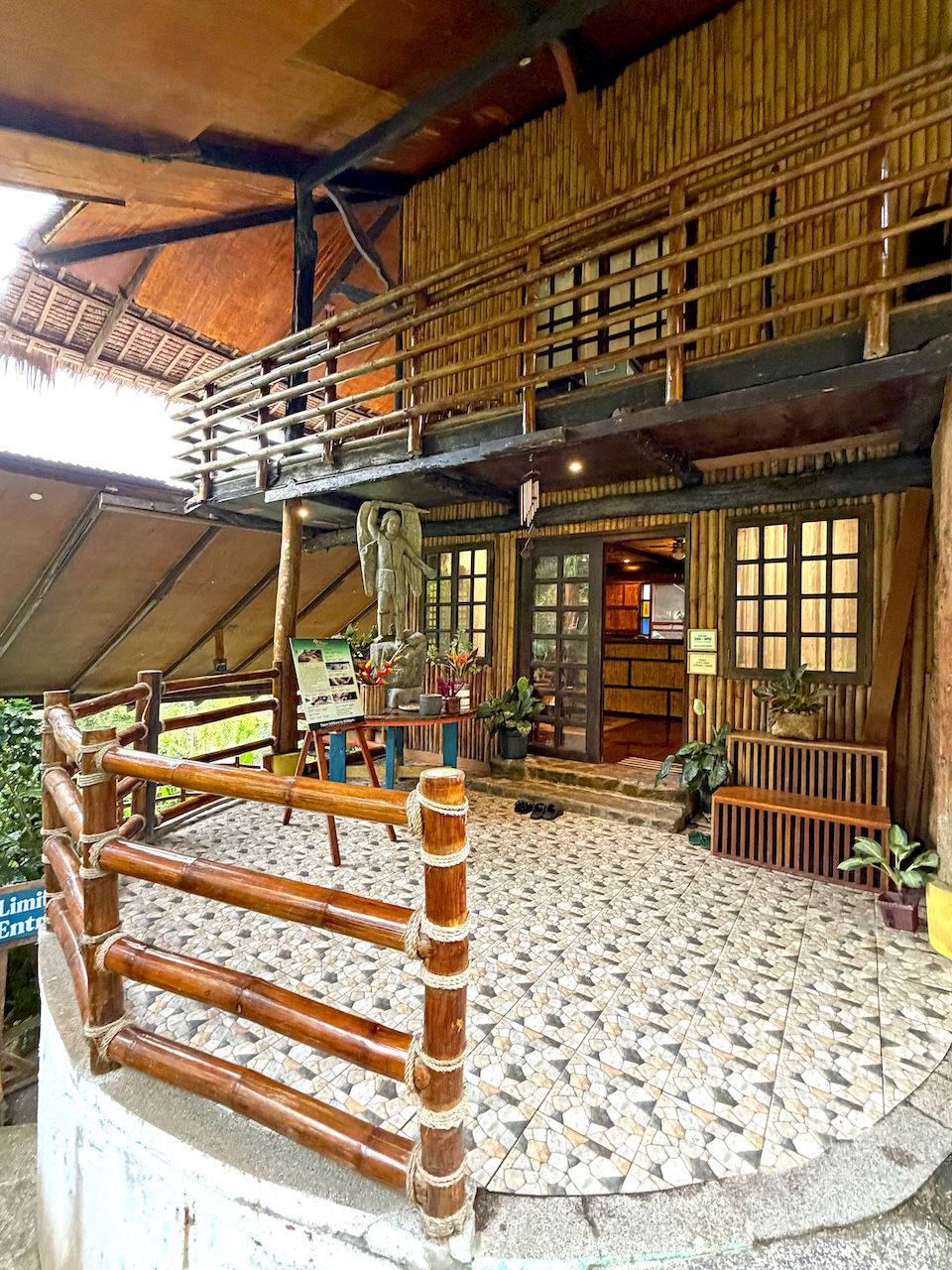
The resort's Ilaya Spa features exclusive pampering rooted in traditional Filipino healing practices.
Food, of course, is where the farm truly sings. The restaurant, Balay Uma, sits like a farmhouse on the verge of the garden, its windows framing the verdant hills.
The menu is a dialogue between Filipino and Ilonggo classics—adobo, kare-kare, KBL (kadyos, baboy, langka), kansi—and international fare—steaks, grilled fish, pizza, pasta, vegan spring rolls, and fresh salads. Every bite reminds diners that the kitchen’s heartbeat lies in the fields that surround it.
During a hearty lunch, chef Jane Mayordomo whips up a veritable feast that includes such creative concoctions as Binusog na Bangus, Binakol na Manok, the surprisingly savory Young Jackfruit Carnitas, Cranberry & Quinoa Salad, and Nilasing na Hipon. To cap the meal, she serves the house’s pride—Hot Choco with Biscocho.
“Food at Balay Uma is a mix of traditional, fusion, and international flavors to give diners more choices,” says Mayordomo.
“We serve traditional food like adobo and kare-kare. Of course, the menu offers many well-loved Ilonggo dishes. The restaurant also serves a wide variety of Western favorites—steaks, an assortment of fish dishes, pizza, and pasta. We also have vegan options, like our Vegetable Spring Rolls and fresh salads.”
“But what truly sets us apart is the freshness of the ingredients we use. With newly harvested vegetables and fruits, food becomes more flavorful, more aromatic, and more satisfying.”
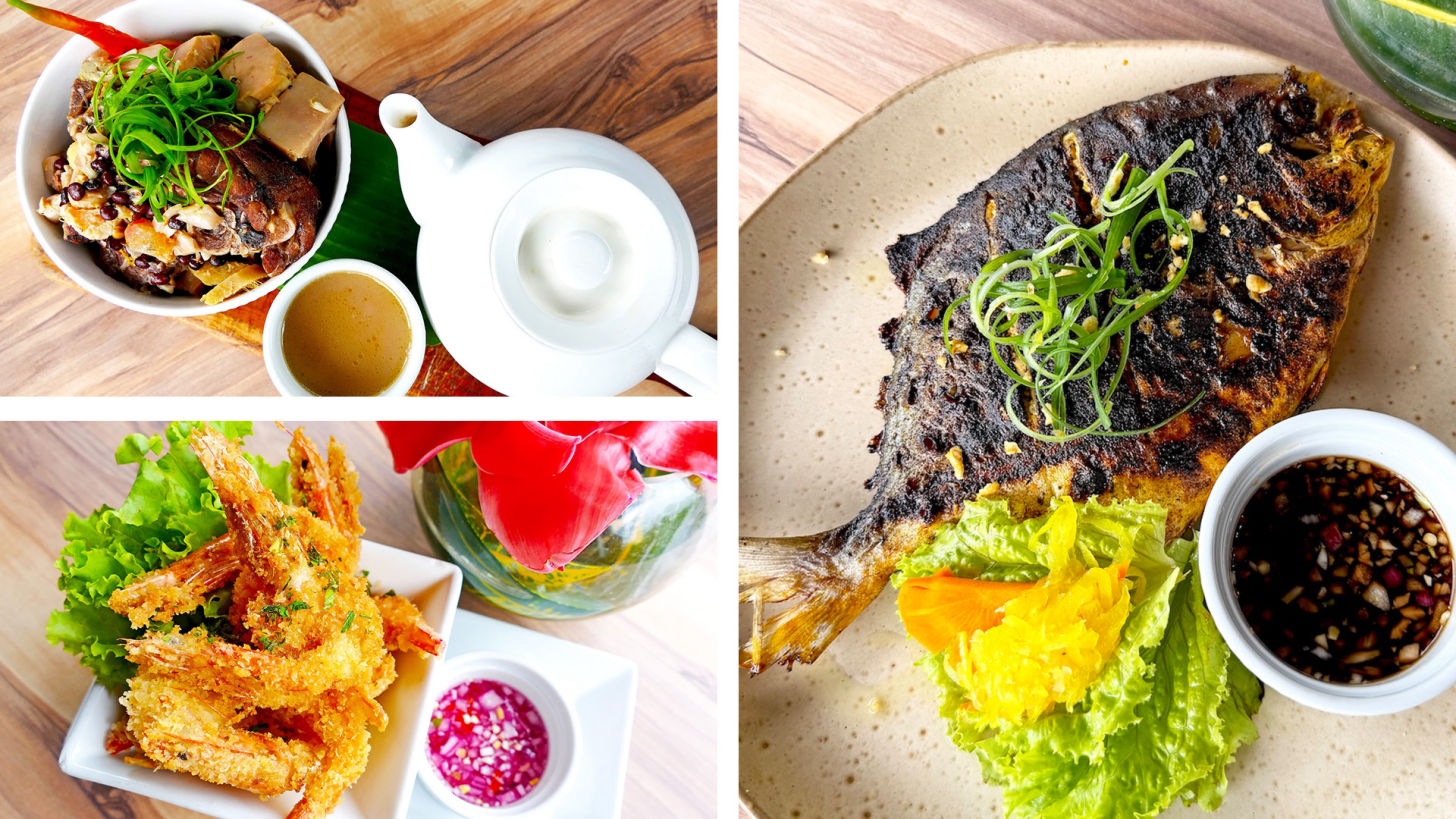
At Balay Uma, foodies will delight in the fresh flavors of the KBL (kadyos, babpy, kag langka), Nilasing na Hipon, and Grilled Pampano.
“Almost everything on the plates is grown on the property,” Tirador discloses with pride.
“We grow a variety of tropical fruits and root crops—rambutan, papaya, coconut, banana, langka, cassava. Our farm also produces lettuce, cucumbers, string beans, peppers, cabbage, and calabaza.” Meanwhile, the farm’s rice paddies in Janiuay and Pototan yield 120 to 150 sacks per hectare.
Dr. Louis Tirador, the brains—and brawn—behind Damires Hills Farm & Spa Resort, is a physician turned farmer, a man who jokes that his true calling lies in the soil. Over decades, he turns the estate into a nature reserve that remains productive.
His most prized accomplishment is the green rapid and romaine lettuce harvested daily, its leaves a vivid green that seem to hold the whole hill’s freshness.
More recently, Dr. Tirador turns his attention to cacao. A single-origin plantation, tended with the patience of a monk, now yields beans that travel to Balay Tablea for fermentation, roasting, and pressing.
“What we grow here is single-origin cacao,” explains farm manager Bejay Launio.
“Single-origin chocolate bars are born from cacao beans that come from one place—sometimes a single farm—allowing the land itself to reflect its qualities through the taste. The hills, the soil, the climate, and the geography create a signature note in the beans. So the flavor of the chocolates we produce points straight to our plantation.”
I’m no chocolate expert, but the result is a line of Damires Hills tablea bars, fine chocolate, and other cacao products that carry an unmistakable fruity flavor—soil, climate, and geography all speaking in each bite.
Education and sustainability are woven into the resort’s fabric. School groups and corporate teams can join a farm-tour program that walks them through seedling planting, organic pest-control methods derived from farm by-products, and the full chocolate-making process—from fermenting pods to the final hot-cocoa demonstration.
The newest jewel of Damires is the Gardenia Pavilion, which opened late last year. Seating nearly 400 guests, its spacious veranda opens onto the rolling hills, allowing sunlight and the surrounding landscape to become part of every celebration.Weddings, corporate events, family milestones—all become immersive experiences where nature itself is a guest of honor.
As the sun begins its slow descent, painting the hills in amber and gold, the resort feels less like a collection of rooms and amenities and more like a living poem—one where each stanza is a different facet of the hill.
I leave Damires Hills with a heart full of new sounds—the rustle of leaves, the splash of water, the soft clink of chocolate being broken—each a reminder that hospitality, at its most honest, is not about creating an escape, but about inviting someone to listen, to feel, and to become part of a place that has been waiting, patient as the earth, for a visitor who will hear its quiet song.
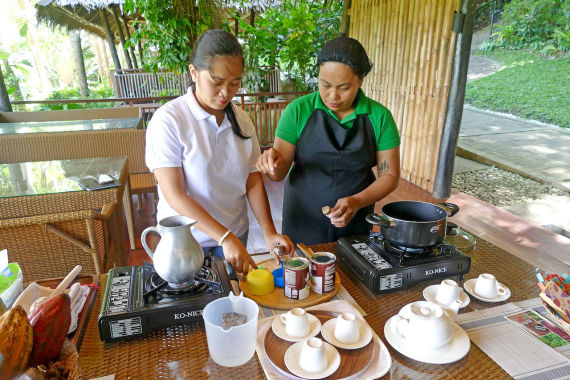
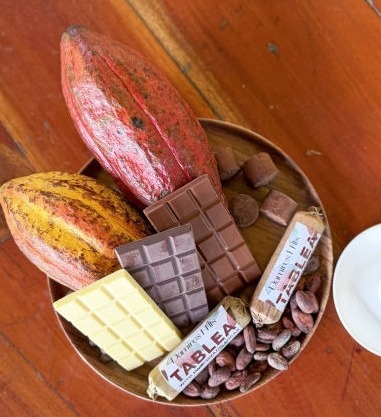
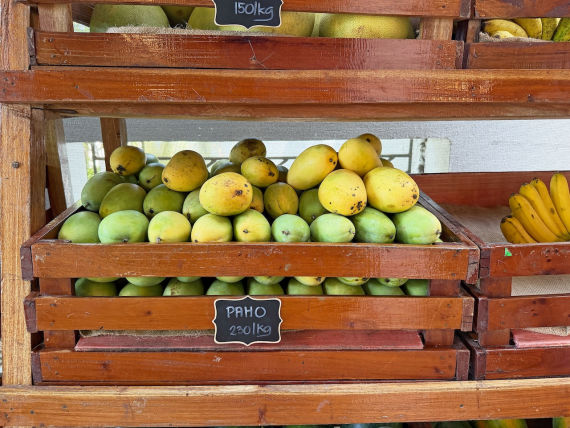

In it's own farm, the resort grows an assortment of fruits, salad greens, and cacao- which are made into a rich chocolate drink or velvety chocolate bars.

Drag & Drop Website Builder