
words by Ria de Borja
images by Gabriel Dela Cruz
Las Flores, which translates to “The Flowers” in Spanish, occupies a prime spot in BGC, delivering what its name suggests: a bouquet of contemporary Spanish flavors in the heart of Manila’s business district. This modern Spanish tapas restaurant and cocktail bar, part of the Bistronomia group, has established a reputation for serving authentic Spanish cuisine with contemporary flair.
The restaurant’s interior strikes a balance between sophistication and warmth. The space is designed for both intimate conversations and celebratory gatherings, with lighting that shifts from business lunch to evening romance. The contemporary styling respects Spanish aesthetic traditions without feeling like a cliché.
Service at Las Flores operates in an effortless manner. Servers demonstrate genuine knowledge of both the menu and wine pairings, and timing between courses flows.
Our dinner began with what would prove to be a carefully orchestrated progression of flavors and textures. The Salmon & Salmon opened the meal: marinated salmon with dill, salmon roe, truffle cream, honey and air baguette. The dish demonstrated technique; the salmon showed proper marination, the roe provided textural contrast and the truffle cream added richness without overwhelming the fish’s natural flavor. The honey offered subtle sweetness, while the air baguette served as an effective vehicle for the various components.
While salmon isn’t traditionally Spanish, the country’s culinary landscape varies significantly by region. Spanish cooking varies greatly from region to region, linked to local products and traditions. Galicia, for example, is famed for its seafood, including dishes of baby eels and Vizcayan-style codfish, while modern Spanish chefs have proven adept at incorporating international ingredients into their established flavor vocabulary.
The Chipirones Andaluza, fried baby squid with kimchi mayo, followed. As Anthony Bourdain once observed, “Good food is very often, even most often, simple food.” This dish exemplified that principle. The squid was properly tender, the coating achieved the right crispness and the kimchi mayo provided an unexpected but effective fusion element. The dish succeeded because the fundamentals were sound: quality squid and a proper frying technique.
Croquetas de Jamón Ibérico arrived as golden orbs with the requisite crispy exterior yielding to a creamy interior. The jamón ibérico quality was immediately apparent. This wasn’t generic cured ham but the genuine article, with its distinctive nutty complexity clearly present in the béchamel base. The balance between saltiness and richness showed careful calibration.
Jamón ibérico represents one of Spain’s most prized culinary products. According to Spain’s denominación de origen rules, dry-cured jamón ibérico must be made from either pure-breed Black Iberian pigs or cross-bred pigs at least 50% Black Iberian. The black Iberian pig lives primarily in the central and southwestern region of the Iberian Peninsula, which includes both Portugal and Spain. After weaning, the piglets are fattened on barley and maize, then allowed to roam in oak groves known as dehesa to feed on grass, herbs, acorns, chestnuts, and roots. For the finest grade, jamón ibérico de bellota, pigs roam oak forests and eat only acorns during the montanera season. The curing process takes at least twelve months, although some producers cure their jamones ibéricos for up to 48 months.
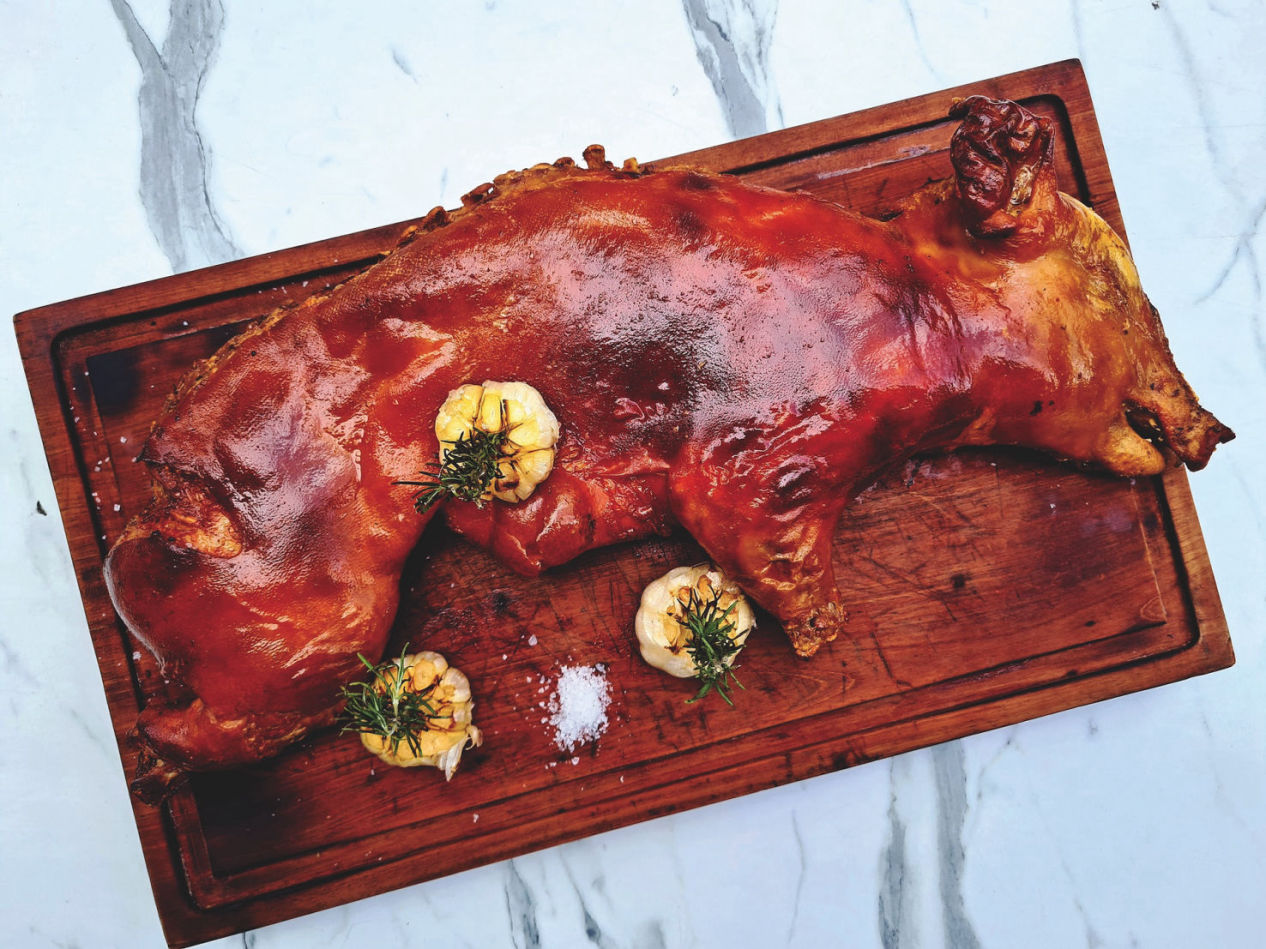
Absolutely delicious cochinillo.
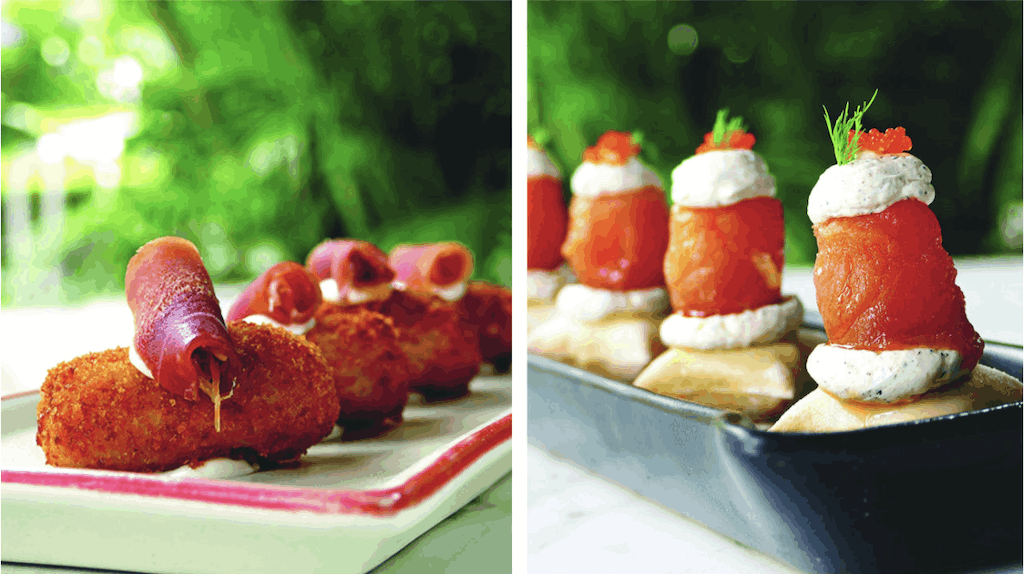
From left to right: Croquetas de jamon; a light but filling salmon dish.
The Paella Negra served as the evening’s centerpiece, arriving in a traditional paellera that suggested serious respect for the dish’s origins. The black rice, colored by squid ink, created a dramatic canvas for the baby squid, shrimps, and scallops. The squid ink provided color and subtle brininess without overpowering the seafood components. Each grain of rice carried oceanic flavors, while the aioli offered garlicky richness that unified the various elements. This version respected paella’s essential character while making its own contemporary statement.
Paella carries significant historical weight in Spanish cuisine. Valencian paella originated in the rural areas of Valencia, near the Albufera, around the 15th or 16th century. Farmers and shepherds cooked rice mixed with ingredients they had on hand, such as chicken, rabbit, snails and vegetables from the local fields, all cooked outdoors. The word paella actually refers to the pan itself, derived from the Latin patella. Stirring is an absolute no-no to form the highly prized socarrat, a caramelized layer of crunchy rice at the bottom that’s considered the mark of proper preparation. Today, there are three officially recognized types: Paella Valenciana, Paella de Mariscos (seafood), and Paella Mixta, though purists maintain that only the first truly deserves the name.
The Cochinillo represented the meal’s most technically demanding offering. Roasted suckling pig prepared Segovian style requires precise timing and temperature control. The skin achieved proper crispness, the meat was fork-tender and the fat had rendered correctly throughout. This demonstrated real kitchen competence, as suckling pig is notoriously unforgiving and demands both skill and patience.
The meal concluded with Churros con Chocolate. Fresh from the fryer, the churros achieved the proper textural contrast between crispy exterior and pillowy interior. The chocolate was thick and rich. The vanilla ice cream provided a temperature contrast that enhanced each bite.
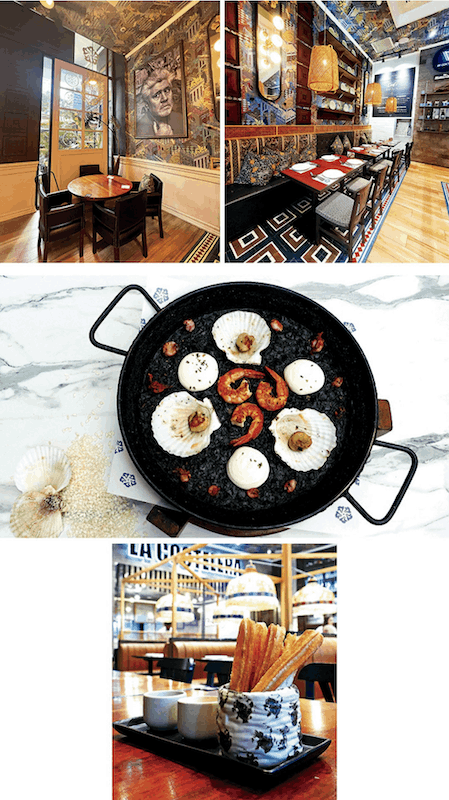
Top to bottom photos: Corner seating with art work of Pedro Almodovar on the wall, a view of the dining space, tasty paella negra , the famed Spannish Churros con chocolate.
Las Flores creates an experience that extends beyond simply serving well-prepared food. It operates as part of the Bistronomia group, which brings a level of operational sophistication that shows in every aspect of the experience. The wine list demonstrates depth and thoughtful curation, with selections that genuinely complement the menu rather than simply filling price points. The cocktail program shows similar attention to detail.
The restaurant’s BGC location could have resulted in another generic corporate dining destination, but Las Flores has developed something more distinctive. The after-work business crowd mingles comfortably with couples on date nights, solo diners feel welcome at the bar, and the food consistently delivers.
What distinguishes Las Flores in Manila’s competitive Spanish dining landscape isn’t revolutionary innovation but rather consistent execution of established principles. From the thoughtfully designed interior to the carefully selected music, from knowledgeable service to properly prepared food, every element works toward a coherent vision of contemporary Spanish dining.
Spanish cuisine’s global influence stems from its ability to balance rustic origins with sophisticated technique, and Las Flores demonstrates this balance effectively. The restaurant succeeds not by attempting to revolutionize Spanish food but by executing it skillfully within a thoughtfully designed contemporary framework.
In a dining scene where restaurants often chase trends at the expense of consistency, Las Flores has built something more sustainable. It’s a destination that warrants repeat visits, not just for individual standout dishes but for the complete experience. The restaurant understands that authentic doesn’t necessarily mean traditional in presentation, and contemporary doesn’t require abandoning classical techniques.
Las Flores is located at G/F, One McKinley Place, 4th Avenue corner 25th Street, Bonifacio Global City, Taguig. Reservations recommended and can be made through bistronomia.ph/reservation.

AI Website Generator