Cordoba: My 48-Hour Inamorata
How much can one enamored traveler absorb of an enthralling place within the tight frame of just around two days? Is it even possible? We show you that it is.
WORDS BY WILLY MARBELLA
IMAGES BY GABRIEL DELA CRUZ
PUBLISHED JULY 1, 2021
Exotic. That is the one word that I feel best describes Cordoba. From Islamic arches to delightful patios, and a flamenco dancer pitting her terpsichorean skill with a horse, I was so impressed by these visual treats that the word “exotic” seemed to grow a new meaning for me. These are all just some of the delights that Cordoba has, where everything appears to be connected by narrow passages instead of boulevards and wide avenues. The intimate scale of the city has enamored me in less than 48 hours.
Cordoba’s history started with the Roman settlement, later taken over by the Visigoths, and eventually becoming a Caliphate and capital of a Muslim emirate. At a certain point, it was the largest city in Europe. “It took only seven years for the Moors to conquer Andalucia, but it took the Christians 800 years to get it back,” according to our guide from Cordoba, Laura, whose model-like looks become even more impressive with the fact that she is on her way to a Ph.D. “Or what we call the Reconquista or the re-conquest of al Andalus, when the Christians under King Ferdinand of Aragon and Queen Isabel of Castille took back Granda, the last stronghold of the Moors in 1492.”
“But before all these, it was a peaceful co-existence between the Christians, the Moors and the Jews,” added Lola, our guide from Andalucia.
THE MEZQUITA
Clearly the jewel of Cordoba is the Mezquita. It was a Great Mosque ordered and built by Abd al-Rhaman. “It subsequently grew as other Muslim leaders added to it during the time of their rule, until the Christians were able to take it back from the Muslims during the re-conquest era and a Roman Catholic Church was built inside it,” Laura explained as we made our way inside the Mezquita from the side entrance.
Upon entering the Mezquita or the Mosque Cathedral, I could not contain my elation as I let out a little yelp. Lola was clearly amused that I was that happy. I literally felt like a kid in a candy store. I read in a travel guide that it was “a forest of columns,” and indeed, it was. But it was the stripped double arches and multi-lobe arches that really fascinated the interior designer in me. The repeating pattern was hypnotic. I was mesmerized by the breadth and depth of how many there were. Laura proceeded to tell us of the differences between the columns, what period they were done, where they were taken from, and the nuances of each one in relation to the period when they were created. Then she gave special attention to the mirhab or the door that “pointed to Mecca.”
“This is the mirhab, or the semi-circular structure that should lead the faithful to the direction of Mecca. A guide, if you will, where to face during prayer. Unfortunately, they found out that it was facing the wrong direction,” Laura explained. Back home, I tried to dig a little deeper to the mystery. I found an online dissertation by David King explaining the mystery, but it is long and arduous. However, if only for the beauty and the magnificence of this golden structure, it was worthy of observation, inspection and scrutiny by its audience.
Also inside the Mezquita is a gigantic monstrance in gold and silver. I felt a little disconcerted of this essentially Christian relic seating in the middle of this very Moorish structure. It threw me off the loop but it essentially highlighted Cordoba’s role in the history of the battle between the two religions. To miss Cordoba during a visit to Andalucia is like missing half of the region.

THE ANDALUSIAN HORSE AND THE FLAMENCO
Andalusian horses are some of the most exceptional and elegant horses in the world. Their history goes as far back as 30,000 BCE as confirmed by the cave paintings all over Spain. King Philip II, who was a great lover of horses, established the Royal Stables of Cordoba precisely to propagate and promote the Andalusian horse, and it has persevered. So, after refreshing ourselves with all the history and beauty of the Mezquita, we set out to watch the elegance and grace these horses were known for.
As we entered the stables, I saw men in costumes, complete with berets decorated with ostrich feathers, walking the horses. Little did we know we were a tad late and Lola was trying her best to get us in ASAP. As we entered the venue, an elegantly dressed “cowboy” in a three-piece gray suite, complete with matching hat, shiny chaps and a very long stick, was doing his routine. With his horse, they covered the entire arena as the caballero had the horse strutting to the music. After his routine, in came the other caballero. His routine was a little more exhausting because he was at the back of the horse directing the horse what to do. He obviously had to rein him in because otherwise he can get dragged by the powerful animal. Again, they were strutting and prancing to the beat of the music. But the main event was at the very close, when a flamenco dancer came in, performed some dance moves, and all of a sudden the gate opened, and a caballero on horseback strutted in and began to dance around the flamenco dancer. Together with her manton de manila, she twirled, stamped and tapped to the music. She did braceo movements (elegant arm movements) with her maton as the caballero gingerly guided the horse within swiping distance to the dancer. It had to be precise because the timing of the music and the distance between horse and dancer tells the story of the dance. It was an interaction and corroboration in rhythm, elegance, grace and power – and this happens only in Cordoba.
The Patio Houses
Every May, the city of Cordoba comes alive with an explosion of colors. Geraniums, jasmines, tuberoses, carnations, roses, bougainvillea – name it, as long as it is flowering, it is there. However, most of these flowers are not on the street but in the courtyards in the houses of Cordoba. Laura, our beautiful guide who could have been a muse for this festival, was able to bring us around some of these houses that have kept the tradition alive even though it was still too early for the festival.
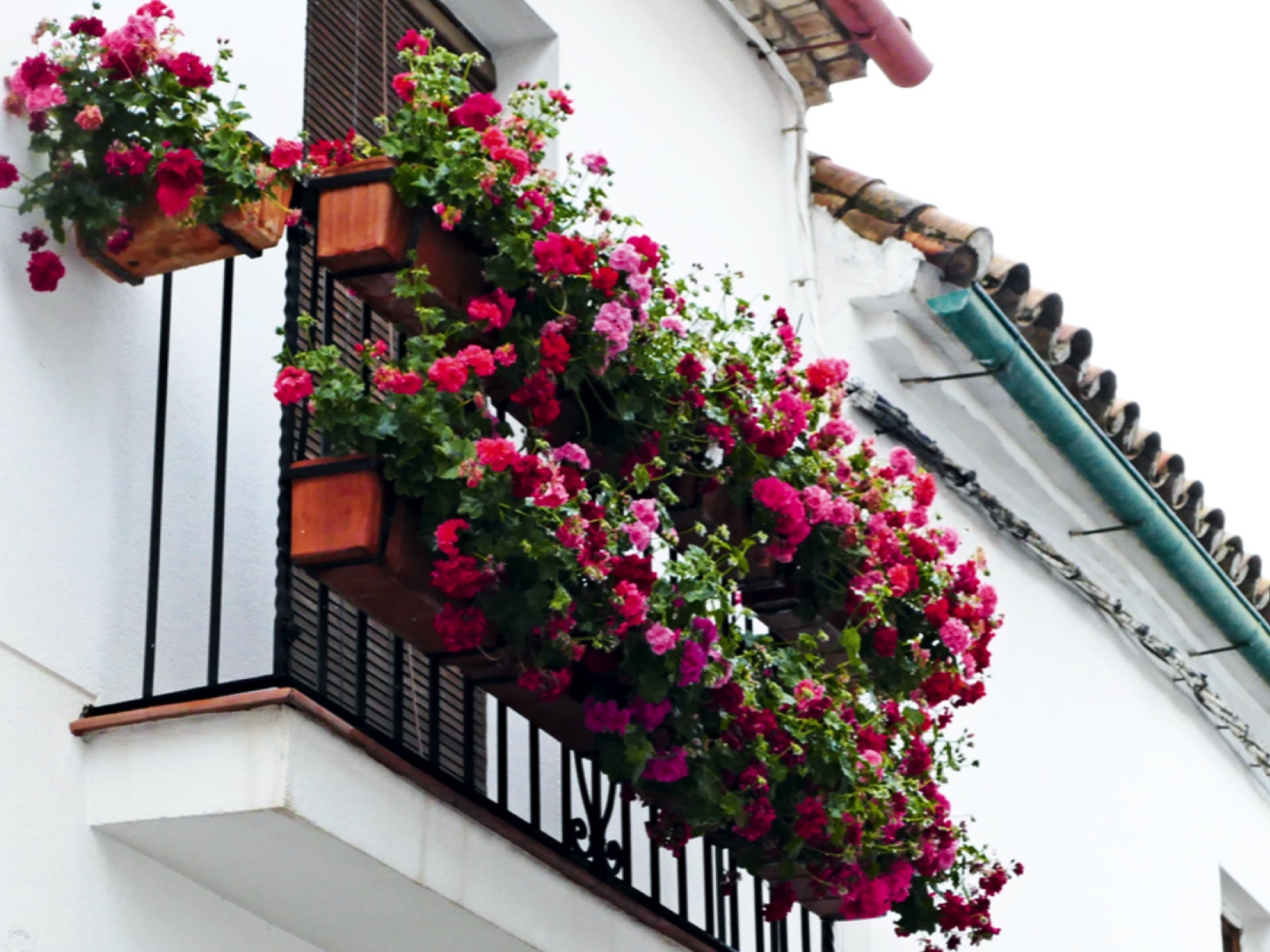
The first house she brought us to was a consistent winner. Against the backdrop of a white washed wall, identical pots were planted with geraniums of only pink and red. It was a sight to behold. If vertical gardens are the fad today, Cordoba was ahead of its time. Try to imagine four walls surrounding an open courtyard. You feel like Aphrodite being wooed by one of the gods and the way he shows it is by magically surrounding you with flowers. It was a delight to see such beauty. There was absolutely not one pot that was without a flower. But my absolute favorite was another house that had artisan and craftsmen as tenants and owners of the quarters inside. As we entered, there was a souvenir store, then inside was a shop of fans, another one sold leather goods, and another had art and other artisanal products that are traditional to Cordoba.

Right across the entrance in the middle, was a staircase that had greeneries cascading down the side of its rail-handle. Hanging from the eaves of the second floor were potted geraniums of different colors and varieties. At the balcony railing are more geraniums that are so lush they were cascading down and covering the entire balcony with blooms. Somewhere in the middle of all these are lush ferns, adding more fullness to the already thick flora. At the ground level, every inch of wall was covered by some kind of plant, all randomly chosen and whose only job was to cover anything that was white. It was so opportune that there was a man, working on some terra-cotta pots on a wooden bench and it was just magical. It felt like Van Gogh could not have composed it any better. This particular patio house brought two of my most loved things together – plants and art. “So where do I sign up to volunteer in this house?” I teased Laura.
And this is Cordoba. Its intimate nature made me feel like comparing it to a beloved aunt whom I always looked up to for comfort. There was familiarity, warmth and a shared history. It made me feel at home with an ardor that only a loved one can get across, all in two short days.

EXPLORE MORE


GET IN TOUCH WITH US
FOLLOW US

Copyright © 2021 AsianTraveler Magazine. All rights reserved.