GENEVA
In step with timelessness
The city famous for its watchmaking industry, banking efficiency and Reformation legacy was among writer Willy Marbella and photographer Gabriel Dela Cruz’s essential Swiss stops.
WORDS BY WILLY MARBELLA
IMAGES BY GABRIEL DELA CRUZ
PUBLISHED AUGUST 3, 2021
Something beautifully peculiar caught my attention right before we began our Geneva day tour. Our team just finished checking-in and got out of the elevator on the eighth floor to get to our rooms first, when a wallclock captivated my interest.
It was an artistic piece, and looking at the open shaft, it goes all the way down to the ground floor. I have never seen a clock that huge and as creatively designed. But we had a full day ahead, which kept me from lingering on the clock’s craftsmanship. Anyway, I was certain I will have a bit more time with it after we got back.
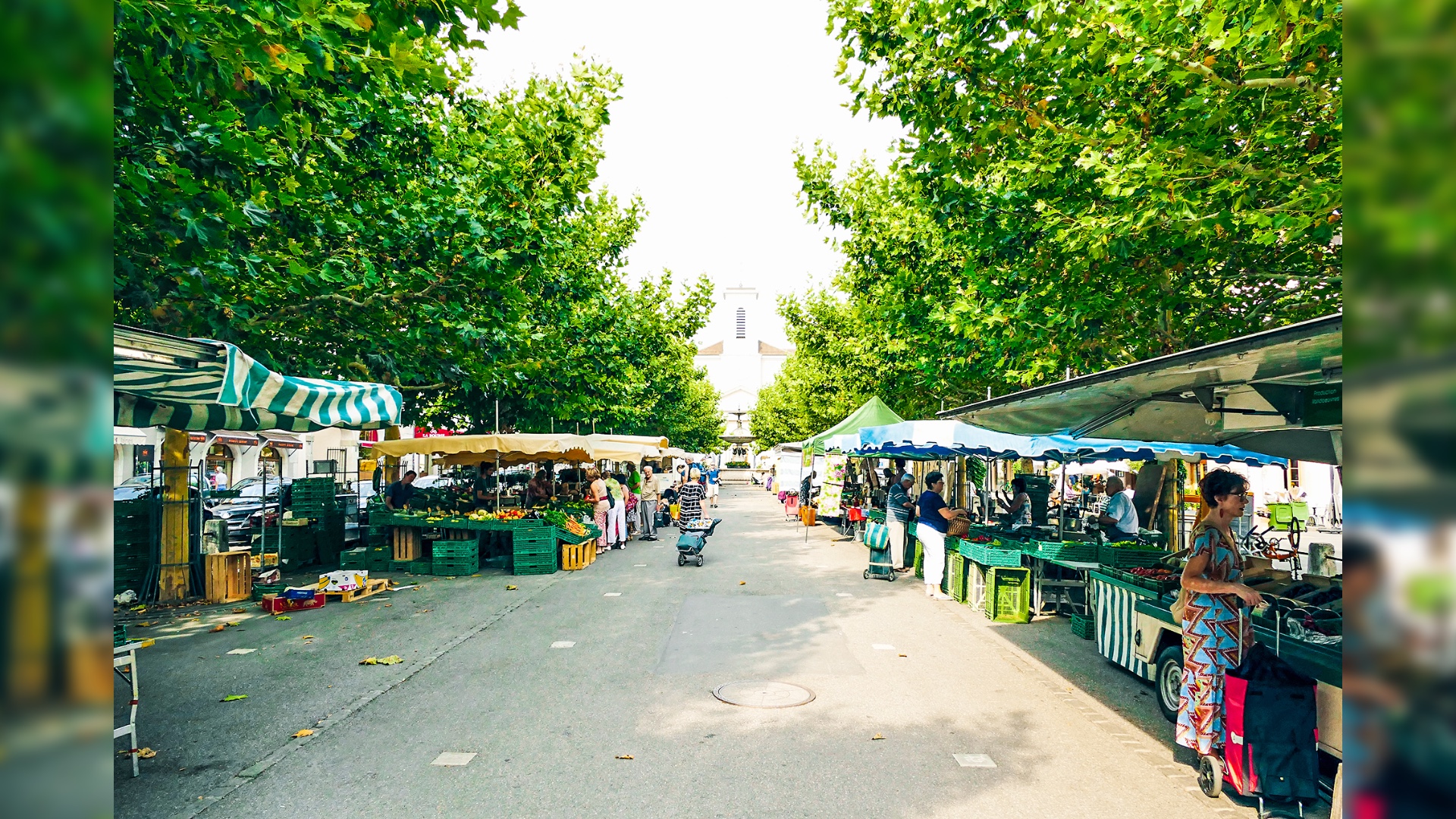
“Let me take you to the historic town of Carouge. It’s a very small town of only one square mile, with a little over 20,000 people,” said Shiva, our team’s guide, as she led us to the day’s first order of business. “[We will also pass by] the open market that happens every Wednesday and Saturdays. Here you can get local wines, fresh fruits, vegetables and flowers, all grown locally.”
I found the market looking rather intimate. It’s not too big that I’ll get lost in it, but just right that one can get everything one needs for at least a week or until the next market day.
“Local wine!” said our publisher-photographer Gabe, who also happens to be a wine enthusiast. “Good to know that they produce their own wines here in Carouge.”
“Yes, we grow our own wine. This market is very popular that even people from the city center come here to shop.” After a perusal of the goods for sale, Shiva declares, “OK, now let’s go to some of the fountains that Blavignac was commissioned to do for the city.”

We approached a two-tiered fountain, surrounded by a pool with flowers at the center-axis. In the middle tier, water continuously arches towards a seated man at the center, and at the bottom, it flows out from the bills of the black swans. I can imagine this to be progressive during its time. Instead of doing a monochromatic color scheme, that man and those black swans stand-out like a sore thumb from the whiteness of the marble, I thought.
“If you will look at the label, you will find that it is either blue or red. If it’s red, it’s not potable, if it’s blue, then it’s OK to drink. Very important to remember,” Shiva explained.
“Who is Blavignac?” asked our managing editor Aida. “Blavignac was a local renaissance man. Architect, historian, archeologist among others,” answered Shiva. Next, pointing to the more anesthesized looking structure on the other side, she said, “This is Eglise Sainte-Croix. This is a Catholic Church.”
With Shiva leading the way, we entered the church. “From here, I’d like to show you to the traditional way, how people here live,” said Shiva as she led the way across the neighborhood. We next passed another fountain with an interesting structure that looks like a church tower, again in white, with a black-winged animal with water streaming out of its beak, but doesn’t seem to be a swan. Getting closer, we finally saw a mythical animal with a swan’s body and neck, but with a dragon’s throat and head. Again, one of the four fountains by Blavignac.
The art critic in me came out and I shared my thoughts: “This is a very unusual fountain. It is square, not the traditional circle. The tower, or what looks like a bell steeple, doesn’t occupy much of the pond area, and there are only two spouts of water at opposite sides of the tower. Also, the black birds look disconcerting because they contrast too much with the white tower. Judging from the two fountains we’ve seen, Blavignac has an obsession with black creatures looking distinct against its white background. Not very common to see. But his creatures, mythical or realistic, are always elegant.”
“So, follow me in here and take a look at the courtyard and how the houses are connected by corridors,” Shiva bade us to preceed.

“From here, I’d like to show you to the traditional way, how people here live.”
“It’s very peaceful in here,” observed our managing editor. The layout was like an amphitheater where everything was at the sides, with the center empty, creating an indoor courtyard. There were a few people sitting inside one of the shaded areas, indicating that this was a functioning community despite its age.
“Here in Geneva, we are renters. Almost all houses are owned by wealthy people and they have the houses [leased],” Shiva explained.
After a few more explanations about the life of locals, our entourage chanced upon a store which sells artsy wallclocks.
“Let’s take a look inside, this is Geneva after all,” I persuaded our group. As the group looks around, I noticed one piece in particular, “Wait a minute, that looks like a small version of the clock in the hotel.”
Then Shiva pointed to a picture, “Look, it is indeed a small version of the one in your hotel! You know, there is a reason how watchmaking became the number one industry in Switzerland. When Calvinism was at its height in the late 16th century, people were prevented from wearing jewelry. However, because watches were the only ones permitted for its practical use, the Swiss watchmakers decided to make them as beautiful and as ornate as possible. However, it was only in the mid-17th century when accuracy became a concern. Since then, Swiss watchmaking has become world renowned.”
And just as we were processing that new revelation, Shiva reminded us to be up and about for our next stop, “Come let’s start walking to the lake for lunch. We’re going on a cruise!” We made our way through town, crossing a major boulevard. Just before getting to the lake, we stopped in front of a statue of two women, elegantly dressed, arm- in-arm at the waist.
“You see, Switzerland is [a] confederation of what are called cantons,” Shiva said as she pointed to the elegant monument of two women. “The original or Latin name of Switzerland is really Helvetia, and Geneva is one of the cantons... This monument symbolizes the unification of Geneva with the Confederation of Switzerland or technically the Confoederatio Helvetica. They are looking together towards Switzerland.”
“That’s new to us,” commented our managing editor. “There’s still time. Let’s walk around the park while waiting for the boat to start loading,” Shiva told us next.
We then come across two more fountains, the Fontaine des Quatre-Saisons and the famous Jet d’Eau. The first one is an allegorical interpretation of Europe’s four season, while the latter had a more pragmatic function.
Pointing to the round fountain, Shiva explained, “Here we have an elegant fountain completed in 1869 and it is said that they were trying to copy the fountains of Paris.” Pointing to the Jet E’eau, she said, “Over there is the famous Jet d’Eau, also known as the pencil fountain. Looks very modern but it was actually done in 1886. It was really meant to control and release excess pressure form the hydraulic plants. It has become an accidental symbol of Geneva and a tourist attraction as well. Anyway, let’s head to the boat before we get left behind and you’ll get a better view of it.”

"During those times, benches were used as counters. Merchants would do their business in what is called a banc. And so, it eventually evolved into the word ‘bank."
As we settled in the boat for lunch, Shiva told us about the lake and the different structures around it. Shiva pointed to a gothic-looking structure: “You see, that structure with all the steeples, that’s the Mausoleum of Brunswick.” She proceeds to tell us about that man’s life, about how he got estranged from his family, never had a family of his own, made it on his own, and how he left everything to Geneva but on the condition that he be built a “monument.” Thus, the mausoleum.
As the breeze cooled down the cabin, we feasted on lunch prepared by a Michelin-starred chef. Shiva continued to point out the structures along the river. The Red Cross building, then the United Nations building. She told us about how expensive and exclusive the houses were that look out to the lake.
Back on dry land after two hours, we continued our tour of the old town. First stop was a watch tower, the Place Molard. It’s an old port that opened to Lake Geneva. The waters of Lake Geneva used to come up all the way to this tower. Now, it is an open square with only the medieval tower left to guard the restaurants and the shopping area around it. The tower itself is decorated with the coat of arms of major personalities during the Reformation, and at night, the cobblestoned walk along the square lights up with the word “welcome” in different languages.
It was a short walk from the watchtower to the Paroisse de Saint- Pierre-Frusterie or Cathedral of St. Peter. This Church has an interesting history because it was built Catholic, but was transformed into a Reformed Protestant church during the time of Calvin. In fact, his chair is part of the church’s collection.
“When you enter you will find that church is very stark in keeping with Calvin’s motto of simplicity. Remember, he was protesting against the ostentatious display of wealth by the Catholic Church,” Shiva said. “You will see the stark walls of the Church just as Calvin would have wanted it. But to its side, there is an ornately decorated chapel that Genevans redecorated. Done in Gothic fashion, it’s a church unto itself. It has a pulpit, stained glass windows, even its own pipe organ. Even its ceilings are lavishly painted. When you come out again, you will then see the difference in the decorations. Don’t miss the chair of Calvin.”
Once inside, we indeed saw the difference between how the Genevans lavishly decorated the chapel, and how plain the Reformists’ area was. After viewing the interior of the church, Shiva took us to another well-known landmark of Geneva: the Reformation Wall. Then, ever so quickly, we arrived at the university grounds.

“We are entering the University of Geneva. This university was founded by Calvin himself,” Shiva said. Apparently, the reliefs were done to commemorate Calvin’s 400th birth anniversary and the 350th anniversary of the university. One hundred meters long, its foundation was built into the old city wall. The focal point of this monument are four 5 meter-high reliefs of William Farel, John Calvin himself, Theodore Beza and John Knox, who are the main proponents of the Reformation. The whole wall is dominated by the words, “Post Tenebras, Lux,” which means “After Darkness, Light.” After seeing and hearing all about Calvin’s reformation, Shiva led us across an open-air building, the Old Arsenal.
“Wow look, mosaics!” I exclaimed, since I always found mosaics fascinating. Totally ignoring the canons on display, I asked about the three mosaic murals. Shiva dutifully answered, “The first one is the arrival of Julius Caesar in Geneva. The second one is a market scene in the Middle Ages, and the third one is the persecution of the Huguenots during the Reformation.”
“Do you know [that] the word bank comes from banc?” Shiva asked while pointing to the second mural. “During those times, benches were used as counters. Merchants would do their business in what is called a banc. And so, it eventually evolved into the word ‘bank.’” That sent our group into a collective “oh.”
“The banking system of Switzerland harks back to the 18th century, when wealthy Europeans brought their money to Geneva to avoid the Protestant banking system,” Shiva explained. Again, the Reformation was at the helm of how and why the Swiss banking system has become one of the most secured banking systems in the world. With that all cleared up, the tour reached its end. We were ecstatic and grateful for Shiva’s wealth of knowledge, plus her wit the entire time.
Getting back into the hotel, as we headed back to our rooms, I happened to pass by the clock again. “This wallclock is really a work of art,” I said, finally understanding too how Switzerland became number one when it comes to timepieces. With that in mind, we made preparations for the day’s last activity, dinner, which we cannot be late for. We’re still in Geneva, after all.
View Gallery






EXPLORE MORE


GET IN TOUCH WITH US
FOLLOW US

Copyright © 2021 AsianTraveler Magazine. All rights reserved.